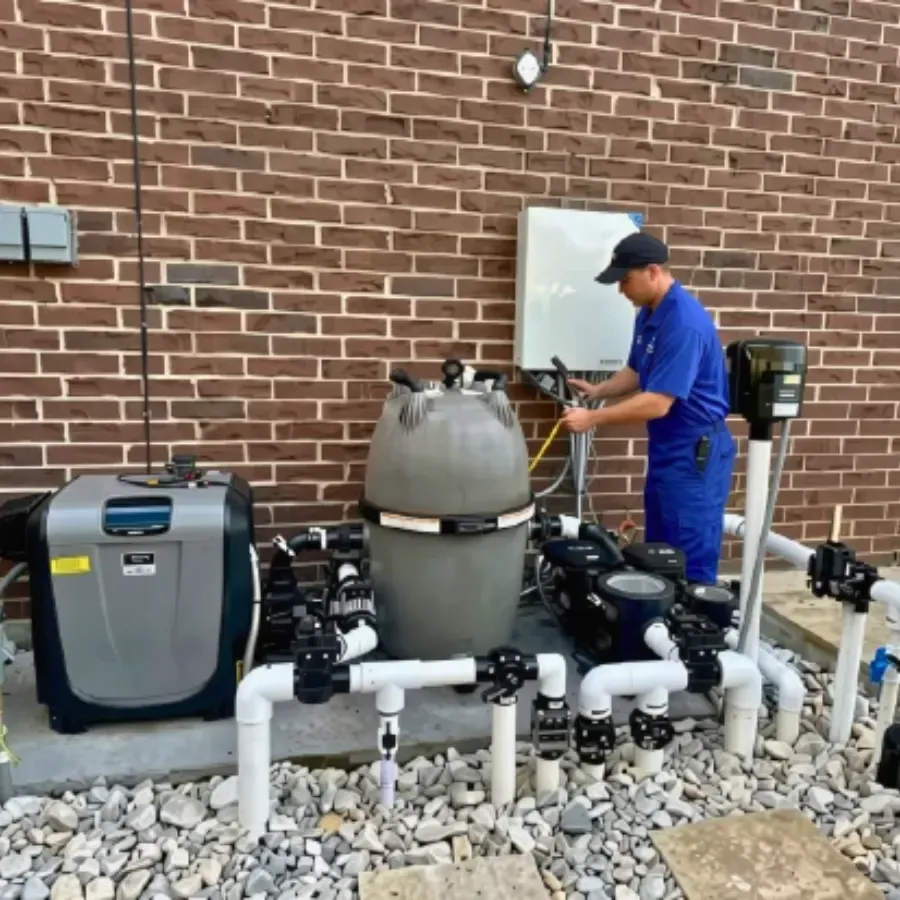
A pool is a small system with a few moving parts. Water goes through a pump and a filter, picks up chemicals and returns clean. If you know what each part does, most care is simple.
This handbook is for new owners and for owners who want a clearer routine. It is organized in seven chapters: new owner basics, the weekly routine, chemistry, equipment, seasons, safety and hiring help. Each chapter points to deeper guides on this site.
Chapter 1: What should a new pool owner know first?
A new owner should know three things: where the equipment is, what normal looks like and who to call. Learn these in the first week and you will solve most problems faster.
Find and name the parts
Walk around the pool and find these parts.
| Part | What it does | Learn more |
|---|---|---|
| Pool pump | Moves water through the system | Pump buyer’s guide |
| Pool filter | Traps dirt and debris | Filter buyer’s guide |
| Pool heater | Warms the water, if you have one | Heater buyer’s guide |
| Skimmer and baskets | Catch leaves before the pump | Chapter 2 |
| Controls, timer or automation | Start and stop equipment | Automation buyer’s guide |
| Chlorine source | Tablets, liquid, or a salt cell | Saltwater vs chlorine |
Take photos of the equipment pad and the labels. Save the model numbers and manuals. If you buy a home with a pool, the home buyer’s pool checklist helps with this first look.
Learn what normal looks like
Write down the normal readings in a notebook or a phone note.
- The filter pressure when the filter is clean
- The water level at the middle of the skimmer opening
- The pump’s normal sound
- The look of the water when it is clear
A change from normal is your first warning. High filter pressure, a loud pump or a falling water level each point to a specific problem.
Know who to call
Keep three contacts handy: a pool service or repair company, a qualified electrician and your homeowner’s insurer. Do not repair electrical or gas parts yourself.
Chapter 2: What is a good weekly pool routine?
A good weekly routine has six steps: test, skim, empty baskets, brush, vacuum and check equipment. It takes less time when you do it every week than when you let it slide.
- Skim the surface. Remove leaves and bugs with a net.
- Empty the skimmer and pump baskets. Full baskets block flow. See skimmer basket and pump basket.
- Brush the walls, steps and corners. Brushing stops algae from starting.
- Vacuum the floor if needed. Use a manual vacuum or an automatic cleaner.
- Test the water. See Chapter 3.
- Check the equipment. Look at the filter pressure, listen to the pump and look for leaks.
Add the filter to the list. Clean or backwash it when the pressure rises above normal, and follow the manual for your filter type.
What does a weekly service visit cover?
Marina Pool Services lists four parts of weekly service.
| Task | What Marina says |
|---|---|
| Water balance | Chlorine, pH, alkalinity, calcium hardness, conditioner level and salt if applicable |
| Baskets | Empty baskets weekly and backwash filters as needed |
| Vacuuming | Vacuum the pool if needed to remove leaves and debris |
| Brushing | Brush the walls and steps as needed |
For a closer look at the service, see the weekly pool service guide and Marina’s weekly pool service page.
How much time does the routine take?
It depends on your pool and the season. A small, clean pool in winter can take less time. A pool under live oaks in spring pollen takes more. If the routine feels like a chore, that is a good reason to look at weekly service or an automatic cleaner.
Chapter 3: How do I manage pool water chemistry?
Water chemistry comes down to a sanitizer and four balance numbers. Keep chlorine working, and keep pH, alkalinity, calcium hardness and stabilizer in range. The full ranges are in the water chemistry chart.
What do the numbers mean?
| Test | What it tells you |
|---|---|
| Free chlorine | Active sanitizer in the water |
| pH | How acidic or basic the water is. It changes how well chlorine works |
| Total alkalinity | How well the water resists pH swings |
| Calcium hardness | Dissolved calcium. Too low can harm surfaces, too high can leave scale |
| Cyanuric acid | Stabilizer that protects chlorine from sunlight |
| Salt level | Only for salt pools |
What are safe targets?
CDC recommends pH 7.0 to 7.8 and a chlorine concentration of at least 1 ppm in pools. If the pool uses cyanuric acid, CDC says to keep at least 2 ppm. CDC also says that a pH above 8.0 weakens the ability of chlorine to kill germs.
Swim University says outdoor chlorine pools need 30 to 50 ppm of cyanuric acid, and salt pools do better at 60 to 80 ppm. It says free chlorine should be about 7.5 percent of the cyanuric acid level. Sources differ, so use your equipment manual and ask your pool pro if you are unsure.
How do I test?
CDC says DPD test kits give the most accurate results and that test strips are less accurate. It also says readings above 10 ppm of chlorine can bleach out a test and show a falsely low or zero result. Always follow the maker’s directions. See drop test kit and test strips in the glossary.
CDC advises testing chlorine and pH at least twice per day, and more often when many people use the pool. Few owners test that often, so choose a schedule you will keep. Test after rain, a storm, a party or any heat wave.
What do I do when a number is off?
Change one thing at a time and retest. Read the product label first. Adjust pH and alkalinity before you add a large dose of chlorine. When the water turns green or cloudy, see the green pool cleanup guide and the step-by-step green pool guide.
How do I handle chemicals safely?
A CDC release says injuries from pool chemicals led to nearly 5,000 emergency room visits in 2012, and more than a third happened at a home. CDC’s tips are to read the label, wear goggles and masks as directed, secure chemicals, keep young children away and never mix different chemicals, especially chlorine products with acid. Add chemical to water, never water to chemical.
Chapter 4: How do I look after pool equipment?
Look at the equipment each week, learn the warning signs and repair small problems before they grow. Small leaks and odd noises rarely fix themselves.
What are the common warning signs?
| Sign | Possible cause | Next step |
|---|---|---|
| Pump is loud or sucks air | Low water, blocked basket, leak on the suction side | Check the water level and basket. Call a pro if it continues |
| Filter pressure is high | Dirty filter | Clean or backwash the filter |
| Water level keeps falling | Evaporation or a leak | Try the bucket test |
| Heater does not heat | Flow, controls or heater fault | Call a pro. Never work on gas yourself |
| Salt system shows a fault | Low salt, dirty cell, low flow | Check the manual, then call a pro |
| Lights flicker or the GFCI trips | Electrical fault | Turn off the breaker and call an electrician or pool pro |
For deeper help, read the pool equipment repair guide. Marina services pumps, filters, heaters, controls and valves. See its equipment repair, pump repair, filter service and heater repair pages.
How long does equipment last?
Equipment life varies with the brand, the run time and the care it gets. The pool equipment lifespan guide gives ranges and signs that a part is near the end. An equipment inspection gives you a clear view of what you have.
When is an upgrade worth it?
Upgrade when a part is failing, when you want to cut power use or when you want better control. ENERGY STAR says reducing pump speed by half lets a pump use one-eighth as much energy, and that running a filter 6 hours a day instead of 24 can cut energy use by 75 percent. Your results depend on your pool and rates. See the pool upgrades guide for salt systems, automation, lighting, pumps and timers.
Who works on what?
| Job | Who should do it |
|---|---|
| Emptying baskets, brushing, testing | You, or a weekly service |
| Cleaning a filter | You, if the manual allows, or a pro |
| Pump, filter or heater repair | A pool pro |
| Gas lines | A qualified pro only |
| Wiring, breakers, lights, bonding | A qualified electrician or pool pro only |
Chapter 5: How do I care for a pool through North Texas seasons?
North Texas has a long, hot swim season, spring storms and pollen, and the occasional hard freeze. Plan for each. The North Texas pool calendar gives a month-by-month plan, and the North Texas pool care guide covers heat, storms, pollen and hard water.
| Season | What to expect | What to do |
|---|---|---|
| Spring | Pollen, storms, debris | Clean baskets more often, test after storms |
| Summer | Heat, sun, heavy use | Watch chlorine and stabilizer, run the pump long enough, keep the water level up |
| Fall | Leaves | Skim and empty baskets often, prepare for cold |
| Winter | Cold fronts, rare hard freezes | Set up freeze protection, check the forecast |
What about freezes?
Freeze protection matters even though freezes are rare. NOAA reports that the February 2021 freeze lasted nearly nine days and that nearly 10 million people lost power at the peak. Pentair says to run equipment continuously until temperatures recover when no automation is present, to use freeze protection with automation, and to consider a full closure when temperatures will drop to 45 degrees Fahrenheit or lower.
Read the freeze protection guide before the first cold front. Marina offers Freeze Guard service, and it repairs freeze damage. See its freeze damage repair page.
What about storms and heat?
Storms bring debris and rain that use up chlorine. Test, brush, empty the baskets and check the chemistry after a storm. Heat burns off chlorine faster. In both cases, a pool that was fine on Monday can turn green by Friday. Use the green pool guide if it does.
Chapter 6: How do I keep a pool safe?
Safety comes from barriers, supervision and careful chemical storage. This chapter matters more than any other.
How do I protect children?
CDC says more children ages 1 to 4 die from drowning than from any other cause of death. It advises these steps.
- Install a four-sided fence at least four feet tall that fully encloses the pool and separates it from the house.
- Designate a responsible adult to supervise closely and constantly when children are in or near water.
- Take swim lessons. CDC says formal lessons can reduce the risk of drowning. Lessons do not replace supervision.
- Learn CPR. Your skills could save someone’s life in the time it takes paramedics to arrive.
Check the gate and latch often. A gate that does not close on its own is a gap. See the glossary for pool barrier, pool alarm and drain cover. City rules on barriers vary, so ask your city before you build or change one.
How do I stay safe around electricity?
Water and electricity are a bad mix. A GFCI is a protective device on pool circuits. If a GFCI trips again and again, or you see damaged wiring, turn off the power and call a qualified electrician or pool pro. Do not work on pool wiring yourself.
How do I store chemicals?
Keep chemicals in their original containers in a cool, dry place. Keep them away from children and pets. Store chlorine products away from acid. Read each label.
What about swimmer health?
CDC advises swimmers to stay out of the water if they have diarrhea, to shower first and to avoid swallowing pool water. It notes that Cryptosporidium can survive for more than seven days in properly chlorinated water. Good chemistry cuts risk, but it does not remove it.
Chapter 7: How do I hire help for my pool?
Hire help when you do not have the time, the tools or the comfort to do the work. Start with what you need: weekly service, a one-time repair or an upgrade. Then compare providers on the same terms.
What type of help do I need?
| Need | Likely service | Marina page |
|---|---|---|
| Regular care | Weekly pool service | Weekly pool service |
| Maintenance plan details | Pool maintenance | Pool maintenance services |
| A part is failing | Repair | Equipment repair |
| Green water | Algae treatment | Algae treatment |
| New equipment | Installation | Equipment installation |
| Cold front coming | Freeze protection | Freeze Guard |
What should I ask a pool company?
Ask these questions and write down the answers.
- What does the service include each visit?
- How do you handle water testing and chemicals?
- Are you insured? What is the proof?
- Who does electrical and gas work?
- How do you quote repairs, and do you give a written estimate?
- What happens if I need to pause or end service?
- Which equipment brands do you work on?
The guide to hiring a pool company in Texas gives a fuller checklist. The glossary explains IPSSA, liability insurance and free estimate.
What does Marina say about itself?
Marina Pool Services is a family-owned and locally operated pool service company based in Grapevine. It says it has more than 20 years of combined pool experience, serves residential pools, and is insured through IPSSA, the Independent Pool and Spa Service Association. It services and installs Hayward, Pentair, Jandy and Raypak equipment. It offers free estimates for qualifying services, and same-day estimates when scheduling allows.
Read about the company on the about page.
How much will it cost?
Marina does not publish prices, and this handbook does not estimate them. Marina quotes each job. For background on what shapes local pricing, read the DFW pool service cost guide.
Where do I go from here?
Use this short list to decide what to read next.
| If you want to… | Read |
|---|---|
| Understand weekly service | Weekly pool service guide |
| Understand repairs | Pool equipment repair guide |
| Understand pricing | DFW pool service cost guide |
| Plan for the local climate | North Texas pool care guide |
| Prepare for freezes | Freeze protection guide |
| Plan upgrades | Pool upgrades guide |
| Clear green water | Green pool cleanup guide |
| Check chemistry ranges | Water chemistry chart |
| Look for a leak | Bucket test guide |
| Hire a pool company | Hiring guide |
| Buy a home with a pool | Home buyer checklist |
You can also browse the full guides index, the glossary and the pool care tips blog. For questions, see the FAQ.
Next step
If you would rather hand off the weekly work, see Marina’s weekly pool service. Call (817) 896-1120 or send a request through the quote form at /contact.
Frequently asked questions
What do I need to do each week to maintain a pool?
Each week, test the water, empty the skimmer and pump baskets, brush the walls and steps, vacuum if needed and check the filter pressure. Confirm the pump runs and the water level is normal. Marina Pool Services weekly service covers water balance, baskets, backwashing as needed, vacuuming and brushing.
How often should I test my pool water?
Test often enough to catch problems early. CDC says home pool owners should test chlorine and pH at least twice per day, and more often when many people use the pool. Many owners test several times a week and rely on weekly service for a full check. Test after storms and heavy use.
What chemicals does a pool need?
A pool needs a sanitizer, usually chlorine, plus balanced pH, alkalinity, calcium hardness and stabilizer. CDC recommends pH 7.0 to 7.8 and at least 1 ppm chlorine in pools, or 2 ppm with cyanuric acid. Salt pools also need the right salt level. Follow product labels.
Should I hire a pool service or do it myself?
Either can work. Doing it yourself costs time and needs a test kit, tools and safe chemical storage. A service handles routine care and spots equipment trouble. Many owners do some tasks and hire help for repairs or busy seasons. Marina Pool Services does weekly service and repairs in Grapevine and nearby cities.
What should I check on my pool equipment?
Look at the pump, filter, heater, controls and plumbing each week. Watch for leaks, unusual noise, high filter pressure and a falling water level. Write down normal readings so you notice change. Call a pro for electrical or gas problems, and never repair those yourself.
How do I keep my pool safe for children?
Use a four-sided fence at least four feet tall that fully encloses the pool and separates it from the house. CDC also advises constant adult supervision, swim lessons and CPR skills. Keep the gate closed and store chemicals out of reach of children and pets.
Pool terms on this page
Sources
- CDC: Home Pool and Hot Tub Water Treatment and Testing
- CDC: Operating Public Pools, Hot Tubs and Splash Pads
- CDC: Pool Chemical Injuries Press Release
- CDC: Drowning Prevention
- Swim University: Cyanuric Acid
- ENERGY STAR: Pool Pumps
- Pentair: Pool Freeze Protection
- NOAA NCEI: The Great Texas Freeze, February 2021
Written by Marina Pool Services and checked against the sources above on October 21, 2026. City rules and product guidance change, so check the linked page before you act. Follow product labels for any pool chemical.