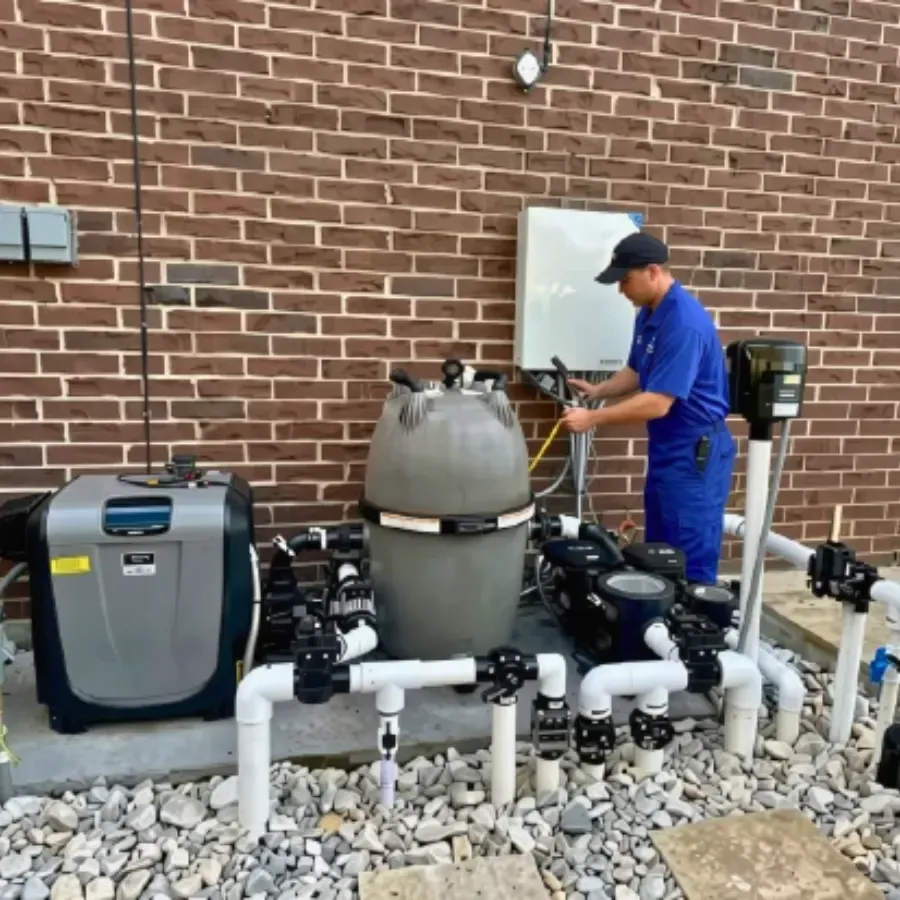
A pool heater lets you swim earlier in spring and later in fall. Picking one is mostly a choice between two machines: a gas heater or a heat pump. They heat the same water in very different ways, and each one has its own limits.
This guide compares them side by side, with a cold-weather note for North Texas. We do not rank brands. We used Department of Energy (DOE) documents and maker manuals that we opened. For heater repair or a new heater in the Grapevine area, see our pool heater repair page.
How does each type of pool heater work?
A gas heater burns natural gas or propane to heat the water. A heat pump uses electricity to move heat from the outside air into the water. Both sit in the plumbing after the filter, and both need water flowing through them.
A gas heater lights a burner, and the flame heats water passing through a heat exchanger. An igniter, a pressure switch and a thermostat control the process. Raypak lists natural gas and propane for its units.
A heat pump works like an air conditioner in reverse. A fan pulls outside air across a coil, and the heat is passed to the pool water. Pentair says a properly sized heat pump should raise a pool about 1 degree F per hour on average. The rate depends on air temperature, humidity and water temperature.
See pool heater for a short definition of the parts.
Gas vs heat pump: how do they compare?
The two differ most in what they need from the weather. This table summarizes what we found in the sources we opened.
| Item | Gas heater | Heat pump |
|---|---|---|
| Energy source | Natural gas or propane | Electricity plus heat from the air |
| Depends on air temperature | No, per DOE modeling | Yes, output varies with air temperature |
| Hayward air operating range | Not applicable | 40 to 115 degrees F |
| Typical heat-up rate | Ask the installer | About 1 degree F per hour when properly sized (Pentair) |
| Installer needed | Qualified installer or gas supplier | Qualified installer or service agency |
| Install needs | Gas supply, venting and clearances | Airflow clearance and electrical supply |
| Average life (DOE estimate) | About 11 years (gas-fired and electric heaters combined) | DOE gives no separate figure that we opened |
On the last row, DOE’s 11-year figure is an average for electric pool heaters and gas-fired pool heaters in its analysis. It is not a warranty or a promise for any model.
Do heat pumps work in cold weather?
They work less well as the air cools and can stop. DOE’s analysis says heat pump output varies with the air temperature around the unit. It says gas-fired and electric resistance heaters are assumed not to vary with outside temperature.
Here is what the makers say.
- Hayward. The air operating temperature for its heat pump is 40 to 115 degrees F, and the water range is 55 to 104 degrees F. Its manual lists a low ambient cutoff fault that clears when the outside temperature reaches 60 degrees F.
- Pentair. Its UltraTemp may enter a defrost cycle when air is near 50 degrees F. It has a low ambient alarm for air too cold for operation, and a low water alarm below 40 degrees F.
- Hayward on defrost. The defrost function prevents the coil from freezing when air is near 50 degrees F. Time in defrost can range from 15 minutes to several hours.
DOE’s analysis gives a sense of the swing. For one efficiency level it modeled, DOE used weighted coefficients of performance (COP) of 5.44 in a hot humid region, 5.20 in a warm region and 3.76 in a cold region. COP is heat delivered per unit of electricity used. These are DOE modeling values for a standard level, not a rating for any product. DOE also noted that rare cases with air too cold for a heat pump could be handled with electric resistance backup elements.
What does this mean in North Texas? Winter nights and cold fronts can push air below the ranges above. If you plan to heat in the cold months, check your model’s range against your local air temperatures. If you only extend the swim season in spring and fall, a heat pump’s range may be fine. A pro can talk you through your plan.
What do gas heaters need?
A gas heater needs a gas supply, venting, clearances and a qualified installer. Raypak says installation and service must be performed by a qualified installer, service agency or the gas supplier. It warns that improper work can cause property damage, injury or loss of life.
Call a qualified pro for gas lines, regulators, venting and any wiring. Do not run, move or repair a gas line yourself.
Raypak’s manual also lists safety points worth knowing:
- If you smell gas: do not try to light any appliance, do not touch any electrical switch, and do not use a phone in your building. Call your gas supplier from a neighbor’s phone. If you cannot reach the supplier, call the fire department.
- Odorant can fade. Raypak warns some people cannot smell the odorant, and that it can fade. It recommends UL-recognized fuel gas detectors in enclosed propane and natural gas installations.
- Clearances. For outdoor installs, Raypak lists 6 inches at the back, 12 inches on the water side and 36 inches on top for a stackless top. Always use the figures in your own heater’s manual and local code.
- Freeze caution. Raypak says not to use the heater to hold water just above freezing, and that it is not warranted against freeze-ups. Between 0 and 32 degrees F, continuous pump flow must be kept. See our freeze guard service.
What do heat pumps need?
A heat pump needs airflow, an electrical supply and a qualified installer. Hayward says its heat pump must be installed and serviced by authorized personnel qualified in pool and spa heater installation. Pentair says only a qualified service person should install its UltraTemp, and that installation must follow national, state and local codes.
Let a qualified electrician or pool pro handle the wiring. Do not wire a heat pump yourself.
Both makers recommend a pool cover. Pentair says a cover reduces heat loss, conserves chemicals and lowers the load on filtration. Hayward gives the same advice and adds that a cover may help as a safety feature. A cover is one of the cheapest ways to keep the heat you have paid for.
How do I size a pool heater?
Size a heater to the pool volume, the temperature rise you want and how quickly you want it. A bigger heater warms the pool faster. A smaller one runs longer.
What to gather before you talk to a pro:
- Pool volume in gallons, and whether a spa shares the water.
- Target water temperature and how many months you want to swim.
- Surface area and shade. A cover and wind shelter help.
- Gas availability. Is natural gas piped to the equipment pad, or would it need propane?
- Electrical capacity. A heat pump draws power from a dedicated supply.
- Pump flow. Raypak lists minimum flows of 20 to 40 gallons per minute for its 206A to 406A models. See our pump buyer’s guide.
Ask the installer for an estimate of heat-up time and running cost for each choice. We do not publish prices, and Marina quotes each job.
What water chemistry does a heater need?
Out-of-range water can damage a heater. Raypak’s manual lists recommended levels, and they differ by pool type.
| Level (Raypak) | Fiberglass pools | Other pool types |
|---|---|---|
| pH | 7.3 to 7.4 | 7.6 to 7.8 |
| Total alkalinity | 120 to 150 ppm | 80 to 120 ppm |
| Calcium hardness | 200 to 300 ppm | 200 to 400 ppm |
| Total dissolved solids | 3,000 ppm maximum | 3,000 ppm maximum |
Raypak notes that in saltwater chlorinated pools, TDS can be as high as 6,000 ppm. Hayward’s manual says water below its saturation index range is corrosive and water above it causes scaling and staining, which is why a heat exchanger needs balanced water and scale control. Keep water balance in range and see our pool water chemistry chart.
What is the DOE rule for pool heaters?
DOE has had efficiency standards for pool heaters since 1990. A final rule amended them. DOE’s page says the amended rule took effect July 31, 2023, and that compliance with the amended standards is required on and after May 30, 2028. The standards are codified at 10 CFR 430.32(k).
The rule applies to manufacturers, and the sources we opened do not require owners to replace a working heater. Ask a dealer how a given model meets the standards. We did not open the efficiency figures in the codified text.
How long does a pool heater last, and when should I replace it?
DOE estimated an average lifetime of 11 years for gas-fired and electric pool heaters, with a spread from 1 to 30 years. Age is only one part of the picture.
Signs it is time to compare repair and replacement:
- The heater is well past 10 years old.
- Repairs keep returning to the same part.
- It fails to light, trips off or loses heat even after a service visit.
- The heat exchanger is scaled or leaking.
- The cost of the repair is close to the cost of a new unit.
Our equipment lifespan guide covers other parts. A technician can inspect the heater and say which parts are failing before you decide.
Which heater should I choose?
The best choice depends on climate use, gas access and how you swim. This table is a starting point.
| If this is you | Lean toward |
|---|---|
| You want heat during cold snaps or in winter | Gas |
| You mainly extend spring and fall in mild air | Heat pump |
| You have no gas line at the pad | Heat pump, or ask about propane |
| You want quick heat for occasional use | Gas |
| You can keep a cover on and run longer hours | Heat pump |
| You are unsure | Ask for both options in a written estimate |
What does Marina service?
Marina services and installs Hayward, Pentair, Jandy and Raypak equipment. On its pool heater repair page, Marina lists pool heater troubleshooting and repair, new heater installation, and equipment service for residential pool systems. Marina does not rank brands. The right heater depends on your pool.
Next step
If your heater will not start or you are comparing options, see our pool heater repair page. Call (817) 896-1120 or send a request through the contact form. For a wider look at repair work, read our pool equipment repair guide.
Frequently asked questions
Is a gas or heat pump pool heater better?
Neither wins everywhere. A gas heater does not depend on the outdoor air temperature, so it suits cold snaps and quick heating. A heat pump uses less energy per unit of heat in mild air but slows in the cold. DOE's analysis assumes heat pump output varies with air temperature and gas heater output does not.
Do pool heat pumps work in cold weather?
They lose output as the air cools and may stop. Hayward lists an air operating range of 40 to 115 degrees F for its heat pump, and Pentair says its unit may enter a defrost cycle near 50 degrees F. Check your model's range against your local winter air temperatures.
How long does a pool heater last?
DOE estimated an average lifetime of about 11 years for gas-fired and electric pool heaters, with a range from 1 to 30 years. Your heater's age and condition depend on water balance, installation and upkeep. A technician can inspect yours and give an honest view of its remaining life.
How fast will a heat pump warm my pool?
Pentair says a properly sized heat pump should raise a pool about 1 degree F per hour on average. The real rate depends on air temperature, humidity and water temperature. A pool cover helps hold the heat. Ask the installer for an estimate for your pool.
Can I install a gas pool heater myself?
No. Gas lines, venting and wiring are jobs for a qualified installer. Raypak says installation and service must be performed by a qualified installer, service agency or the gas supplier, and that improper work can cause property damage, injury or loss of life. If you smell gas, do not light anything and call your gas supplier.
What water chemistry does a heater need?
Poor balance can damage a heater. Raypak lists pH, total alkalinity, calcium hardness and total dissolved solids limits in its manual. For most pool types it lists pH of 7.6 to 7.8, alkalinity of 80 to 120 ppm, hardness of 200 to 400 ppm and TDS under 3,000 ppm. Check your own manual.
Pool terms on this page
Sources
- Department of Energy: Energy Conservation Standards for Consumer Pool Heaters, Final Rule
- Department of Energy: Consumer Pool Heaters
- Hayward: Heat Pump Installation and Operation Manual
- Pentair: UltraTemp Heat Pump Installation and User's Guide
- Hayward: AquaRite Electronic Chlorine Generator Owner's Manual
- Raypak: Digital Atmospheric Gas Pool and Spa Heater Installation and Operation Manual
Written by Marina Pool Services and checked against the sources above on October 21, 2026. City rules and product guidance change, so check the linked page before you act. Follow product labels for any pool chemical.