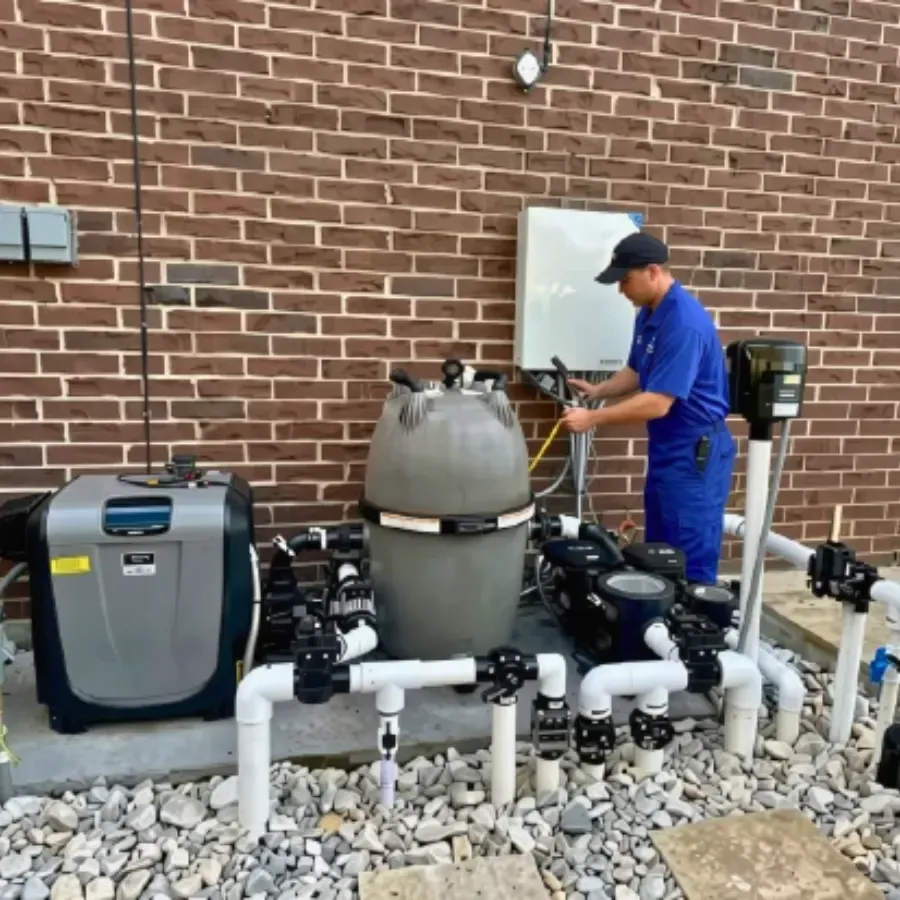
What are the signs that pool equipment needs repair?
Pool equipment usually tells you something is wrong through a symptom, not a message. Weak flow, no heat, strange noise, a high pressure reading, or water that will not clear are the common ones. The symptom points to a part of the system, but the cause is sometimes in another part.
The table below lists common symptoms and the places a technician looks first. It is a guide for understanding a diagnosis. It is not a repair manual.
| Symptom | Where a technician looks first |
|---|---|
| Pump will not start or hums | Power, capacitor, motor, timer or automation setting |
| Pump loses prime or sucks air | Lid, o-ring, basket, suction-side air leak |
| Loud or grinding pump | Motor bearings, impeller, debris |
| Pump seeps water | Shaft seal, unions, housing |
| Weak flow at the returns | Full baskets, dirty filter, clogged impeller |
| High filter pressure | Dirty or worn filter media |
| Heater will not fire | Flow, pressure switch, igniter, gas supply, control |
| Heater runs but water stays cool | Sensor, thermostat setting, heat exchanger, flow |
| Salt system shows low salt or no output | Salt level, scaled salt cell, flow switch |
| Lights flicker or fail | Bulb or fixture, transformer, GFCI |
| Equipment runs at wrong times | Pool timer or automation program |
Look at the pressure gauge on the filter. A reading well above its normal clean value can point to a dirty filter. Write down the normal reading when the filter is clean, so you know what “high” means for your system.
What should I do before I call?
Do the safe things only.
- Note exactly what you see, hear, or smell, and when it started.
- Check that baskets are empty and the water level is at the skimmer.
- Take a photo of the equipment label, the pressure gauge, and any error code.
- If you smell gas, see smoke, or see sparks, turn the equipment off at the breaker and call a qualified professional.
- Do not open a motor or heater cabinet, and do not touch wiring.
Electrical and gas work belong to qualified professionals. Marina’s equipment repair service is built around “equipment inspection and diagnostics,” “repair of pool equipment and components,” and “practical recommendations based on the condition of your system.”
How does pump repair work?
A pump repair starts with finding out why flow is low or why the pump will not run. The pump moves all the water in your pool through the filter and heater. When it fails, everything downstream fails with it.
Common pump faults fall into three groups: air getting in (lid o-ring, unions, priming problems), mechanical wear (motor bearings, shaft seal), and electrical faults (capacitor, motor winding, controls). A technician separates them by checking flow, sound, and power.
Pump type matters for the repair and the replacement choice. A single-speed pump runs at one speed. A variable-speed pump can run slower for filtration. ENERGY STAR reports that reducing pump speed by one-half allows the pump to use just one-eighth as much energy, and that certified in-ground pool pumps use 20% less energy than standard pool pumps. The agency also says running a filter 6 hours a day instead of 24 cuts energy use by 75%.
For a full walk-through, see the pool pump repair page and the pool pump buyer’s guide.
How does filter repair work?
Filter work means finding out whether the filter needs cleaning, a part, or replacement. A filter that does not clean well makes the water cloudy and strains the pump.
There are three common types, and each fails in its own way.
| Filter type | Routine care | Common faults |
|---|---|---|
| Cartridge | Remove, clean, inspect the cartridge | Torn fabric, cracked end caps, collapsed core |
| Sand | Backwash as needed, replace sand over time | Channeling, worn valve, cracked lateral |
| DE | Backwash, then recharge with new DE | Torn grids, cracked manifold, worn valve |
Marina’s filter page describes cartridge cleaning (remove and clean the cartridge, inspect its condition, maintain flow) and DE cleaning and backwashing (backwash, replace DE media, check performance). The pool filter repair page has the details and the pool filter buyer’s guide helps when the choice is to replace.
One mistake to avoid: HomeGuide notes that a replacement pump larger than the filter can push water through too fast for the filter to work properly. Match the pump and the filter as a pair.
How does heater repair work?
Heater repair means finding why the heater will not start or will not heat. Heaters need flow, fuel or electricity, and a working control. A fault in any one stops the heat.
Residential heaters are usually gas heaters or heat pumps. A gas heater burns gas to heat water. A heat pump moves heat from the air into the water. The U.S. Department of Energy’s Better Buildings program notes that heat pumps are more efficient than boilers for pool heating, and that air-source heat pumps work especially well when outside air is warm.
Heater work involves gas, venting, and power. Do not attempt it yourself. HomeGuide lists causes that technicians check, such as clogged tubing, a faulty thermocouple or overheating switch, a leaking heat exchanger, loose connections, and low gas pressure. Marina’s pool heater repair page covers troubleshooting, repair, and new heater installation. See the pool heater buyer’s guide if you are weighing a replacement.
Heat also costs money to hold. The DOE reports that covering a pool when it is not in use is the most effective way to cut heating costs, with savings of 50% to 70% possible.
How do salt cells and chlorine generators fail?
A salt system fails when the salt level is wrong, the cell is scaled, or flow is too low. A salt chlorine generator turns pool salt into chlorine with an electric cell. The cell wears and collects mineral scale over time.
North Texas hard water adds to scale. Grapevine’s 2024 water report lists total hardness at 117 ppm in city water, and evaporation concentrates minerals in the pool. A scaled cell makes less chlorine, so the pool can turn cloudy even though the system looks fine.
Marina’s salt page says it plainly: “Salt water does not mean a pool is maintenance-free.” Salt service covers installation, inspection and service, and troubleshooting. See salt water system installation and the saltwater vs chlorine guide.
What about automation, lights, and timers?
Controls tell your equipment when to run. A fault here looks like an equipment fault, but the equipment is fine. A pump that never starts may be waiting for a command that never arrives.
- Timers and energy controls. A pool timer sets run times. Marina installs timers and scheduling controls. See pool timer installation.
- Automation. Pool automation lets you control pumps, heaters, and lights from one panel or app. Marina covers installation, configuration, and troubleshooting. See pool automation and the automation buyer’s guide.
- Lighting. Pool and spa lighting service covers installation, replacement, and troubleshooting. See pool lighting solutions.
Lights sit in water and run on electricity, so a failed light is a job for a qualified professional. Never open a light fixture while the circuit is live.
How do repairs fit with routine pool service?
Routine service and repair work together. A technician who sees the pool every week knows what normal looks like for your equipment. That makes a change easier to spot.
Marina’s weekly service includes backwashing filters as needed and emptying baskets, and its technicians can identify visible issues with circulation and equipment that may need further inspection or repair. The repair itself is a separate job with a separate estimate. Many owners start with an inspection when they buy a home or when something feels off. See the buying a home with a pool checklist and weekly pool service.
Small habits protect equipment between visits:
- Keep baskets from overflowing in leaf season.
- Keep the equipment pad clear of leaves, mulch, and stored items.
- Watch the pressure gauge and write down the clean reading.
- Report new noise, drips, or error codes early. Small faults cost less than big ones.
- Check that the water level stays at the skimmer, so the pump does not run dry.
Should I repair or replace?
Repair when the unit is young, the fault is small, and the parts are available. Replace when the unit is old, the repair cost is large next to a new unit, or the same part keeps failing. A technician should show you what failed and why.
Age is one input. Premier Pools and Spas published these typical lifespans in a guide dated January 19, 2026:
| Equipment | Typical lifespan (Premier Pools) |
|---|---|
| Single-speed pump | 2 to 5 years |
| Variable-speed pump | 3 to 8 years |
| Filter (sand, DE, cartridge types) | 5 to 12 years |
| Filter cartridges | 1 to 3 years |
| Heater | 4 to 8 years |
| Salt cell | 3 to 5 years |
These are one company’s ranges. Other guides give different numbers, and local conditions such as North Texas heat and hard water change them. The pool equipment lifespan guide goes further.
What do repairs cost?
Marina quotes each job and does not publish prices. Third-party sources give a sense of scale. Angi’s Dallas repair page (updated September 1, 2026) reports a Dallas average pool repair cost of $641, with a normal range of $258 to $1,025. HomeGuide (updated September 22, 2025) reports ranges for pump motor repair of $50 to $300 and replacement of $150 to $800. These are national or regional averages from those publishers and are not what Marina charges. The pool service cost guide explains how to read them.
A simple way to decide
Ask three questions.
- How old is the unit, and what is its typical lifespan?
- Is the fault a small part or the main component?
- Does a newer unit save energy or fix a repeat problem?
If a technician recommends replacement, ask what they found, and ask for the repair option in writing too. Marina states that it focuses on the condition of the equipment and the requirements of your pool rather than recommending unnecessary work.
Which brands does Marina service?
Marina Pool Services services and installs Hayward, Pentair, Jandy, and Raypak equipment, along with other residential systems. That covers most of the pumps, filters, heaters, salt systems, and controls found in North Texas backyards.
If you do not know your brand, look for the label on the equipment pad or send a photo with your request. You can also book a pool equipment inspection, which looks at pumps, filters, heaters, valves, plumbing connections, timers, and controls. For new installs, see equipment installation.
What happens on a service call?
A service call follows a set order: listen, look, test, explain, quote. Marina’s approach is to diagnose the problem and recommend practical solutions based on your pool and equipment.
Here is what to expect from any good technician:
- You describe the problem. Photos and notes help.
- The technician inspects the system. Pump, filter, heater, valves, and controls are checked.
- The technician finds the cause. Ask to see the failed part if it can be removed safely.
- You get options. A repair, a replacement, or both, with the reason for each.
- You get an estimate. Marina gives free estimates for qualifying services. Ask what the quote includes: parts, labor, and any extra trips.
- You approve the work. Nothing starts until you say yes.
Ask whether a diagnostic fee applies and whether parts carry a manufacturer warranty. Marina does not state a workmanship warranty on its site, so ask for any warranty in writing.
Which cities do we repair in?
Marina repairs equipment for homeowners across Northeast Tarrant County. Pages for each area are listed below.
| City | Local page |
|---|---|
| Grapevine | Pool repair in Grapevine |
| Southlake | Pool repair in Southlake |
| Colleyville | Pool repair in Colleyville |
| Keller | Pool repair in Keller |
| Trophy Club | Pool repair in Trophy Club |
| Coppell | Pool repair in Coppell |
| North Richland Hills | Pool repair in North Richland Hills |
| Hurst, Euless, Bedford | Pool repair in the HEB area |
| Flower Mound | Pool repair in Flower Mound |
The full list is on the service areas page. If you also want routine care so small faults get caught early, read about weekly pool service.
Next step
Start with the pool equipment repair page, then call (817) 896-1120 or send the quote form at /contact for a free estimate.
Frequently asked questions
Why won't my pool pump start?
Common causes are no power at the breaker, a failed capacitor, a seized motor, or a timer or automation setting that blocks it. Do not open the motor or touch wiring. Turn the pump off at the breaker and call a qualified technician.
Is it worth fixing a pool heater?
Often, if the heater is young and the fault is small, such as an ignition part or a sensor. If the heat exchanger is leaking or the unit is near the end of its life, replacement may cost less over time. A technician can tell you which case you have.
How long do pool pumps last?
Published guides vary. Premier Pools lists 2 to 5 years for single-speed pumps and 3 to 8 years for variable-speed pumps (guide dated January 19, 2026). Care, run time, and heat all change the real number, so treat these as rough ranges.
Do I need an electrician for pool equipment?
Wiring, bonding, and power to the equipment pad are electrical work. Call a qualified professional for them and do not attempt wiring yourself. Marina can tell you during an estimate whether a job needs electrical work or a separate trade.
Do you offer same-day pool repair?
Marina says that when scheduling allows, it can give same-day estimates for pool service, cleaning, and equipment repairs. It does not promise same-day or after-hours repair, so call (817) 896-1120 and ask about the schedule for your address.
What brands do you work on?
Marina services and installs equipment from Hayward, Pentair, Jandy, and Raypak, along with other residential systems. If you have a different brand, or you are not sure which brand you have, call and ask before you assume it is not covered.
Pool terms on this page
Sources
- Angi: How Much Does a Swimming Pool Repair Cost in Dallas, TX?
- HomeGuide: How much does it cost to own and maintain a swimming pool?
- Premier Pools and Spas: Pool Equipment Lifespan Guide
- ENERGY STAR: Pool Pumps
- Angi: How Much Does Pool Maintenance Cost in Dallas, TX?
Written by Marina Pool Services and checked against the sources above on October 21, 2026. City rules and product guidance change, so check the linked page before you act. Follow product labels for any pool chemical.