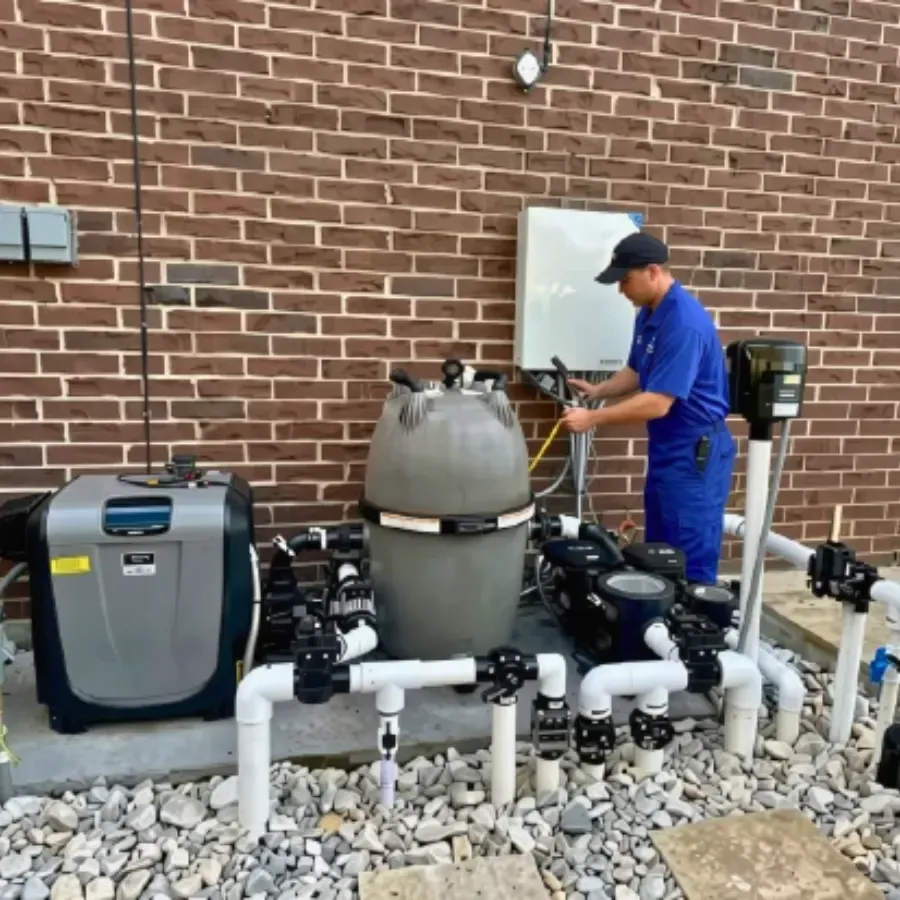
“Saltwater pool” sounds like a different kind of pool. It is not. It is a chlorine pool that makes its own chlorine. This guide compares the two for a North Texas backyard, covering upkeep, pH drift, cell life and what changes for weekly service.
We lean on equipment manuals and published sources that we opened. Where a figure comes from a third party, we name it and give the date. Your own equipment manual always wins. For salt system work in the Grapevine area, see our salt water system page.
What is the real difference between a saltwater pool and a chlorine pool?
A saltwater pool makes chlorine on site. A chlorine pool gets chlorine from products you add, such as liquid chlorine or tablets. Both end up with free chlorine in the water doing the same job.
In a salt pool, a salt chlorine generator sits in the plumbing. Water passes through a salt cell, where electricity turns dissolved salt into chlorine. Hayward explains that the chlorine reverts to salt after it kills bacteria, so the cycle repeats and cuts the need to add sanitizer. The salt level is low enough that, per Hayward, you generally taste it only near 3,500 to 4,000 ppm.
Here is a side-by-side view.
| Item | Chlorine pool | Saltwater pool |
|---|---|---|
| Where chlorine comes from | Products you add | Salt cell makes it |
| Extra equipment | None required | Cell, control box and flow switch |
| What you add often | Chlorine | Acid for pH, some salt, stabilizer |
| Main wear part | None added | Salt cell |
| Cold-water behavior | Chlorine works as added | Cell pauses in cold water |
| Up-front equipment cost | Lower | Higher (see cost section) |
Is a saltwater pool easier to maintain?
It is steadier, not effortless. A cell makes chlorine every time the pump runs, so levels stay more even than with hand dosing. You handle less raw chlorine. You still test the water, balance it and watch the equipment.
Hayward lists the chores. Inspect the cell about every 3 months or after you clean the filter. The control flashes an inspect-cell light after about 500 hours of operation. Pentair says to remove its cell and check for scale or debris at least every two months.
You also keep the rest of the water balanced. Both makers list targets for pH, alkalinity, calcium hardness and stabilizer. See our pool water chemistry chart for the numbers.
Why does pH drift up in a saltwater pool?
Making chlorine by electrolysis tends to raise pH. Sensorex says the process “tends to create byproducts that have a very high pH.” It adds that high alkalinity can push pH up as well.
What this means in practice: expect to lower pH on a regular basis. Sensorex says to test at least twice a week and cites the Pool & Hot Tub Alliance as recommending more frequent testing for salt pools than for plain chlorine pools.
Be careful with the acid you choose. Hayward discourages dry acid (sodium bisulfate) for adjusting pH, especially where water evaporates and is not often diluted. It says dry acid can build up byproducts that damage the cell. Read the label of any acid, store it as CDC directs, and never mix chemicals.
How long does a salt cell last?
DFW Custom Pool, a Texas pool builder, reports that salt cells typically last 3 to 7 years, with 4 to 5 years a realistic expectation. It says an undersized cell may last only 2 to 3 years. This is one company’s figure, so treat it as a range.
What shortens life, according to the makers:
- Scale. Hayward says buildup on the plates points to unusually high calcium. Hard water makes this more likely. See calcium hardness and scale.
- Out of balance water. Hayward says that where chemistry has been allowed to go out of balance, the cell may need regular cleaning.
- The wrong cell. Hayward says generic, uncertified cells can cause early failure, and using a non-genuine Hayward replacement cell voids its warranty.
- Picking too small a cell. Match the cell to your pool size. Hayward sizes its models by pool volume.
When the inspect-cell alert stays on after a thorough cleaning, Hayward says the cell may be worn and need replacement.
How much does each option cost?
The numbers below are third-party figures. Marina Pool Services does not publish prices and quotes each job, so use these only as a rough guide to how the two options compare.
DFW Custom Pool published an article on March 31, 2026. It is a pool builder, not a neutral source. For a typical 20,000-gallon pool, it reports:
| Item (DFW Custom Pool, March 31, 2026) | Chlorine pool | Saltwater pool |
|---|---|---|
| Estimated annual cost, do it yourself | $960 to $2,290 | $760 to $1,745 |
| Installed sanitizing setup | About $200 to $800 | About $2,500 to $4,500 (mid-range) |
| Salt cell replacement | Not applicable | $400 for entry-level to $900 or more for premium, parts only |
The article adds that cell replacement works out to roughly $100 to $225 a year. It does not cover converting an existing chlorine pool, so conversion cost is a separate question.
Your own bill depends on pool size, equipment and water. Ask for a written quote before you decide.
What changes for weekly pool service?
Weekly service for a salt pool covers the same basics as any pool, plus the salt system. Marina’s weekly service covers water balance, including chlorine, pH, alkalinity, calcium hardness, conditioner and salt if applicable. It also covers emptying baskets, backwashing filters as needed, and vacuuming and brushing as needed.
For a salt pool, these checks matter more:
- Salt level. Low salt cuts chlorine output. High salt can shut the unit down, per Hayward.
- pH. It tends to rise, so it needs frequent attention.
- Stabilizer. Hayward says to check stabilizer whenever you check salt on outdoor pools, since the two tend to decline together.
- Cell condition. Look for scale and watch for the inspect-cell alert.
- Chlorine output setting. Hayward says chlorine demand goes up with temperature, so most owners raise output in peak summer and lower it in colder periods.
The cell sits in the plumbing, so it only gets checked when someone opens it. Marina lists salt system inspection and service as its own service. See weekly pool service in Grapevine for what a regular visit includes.
What happens to a salt pool in a North Texas winter?
The cell pauses when the water gets cold. Hayward says its AquaRite stops making chlorine when water falls below 50 degrees F, and it notes that bacteria and algae stop growing at about that temperature. Pentair says its water sensor switches the cell off at about 52 degrees F, give or take 3 degrees, to protect it.
You can run a cell on a cold day by switching Hayward’s unit to Super Chlorinate for a day. Do this only with the maker’s guidance, and keep checking chlorine. Hayward also says most pools need less chlorine in cold weather, so lower the output setting rather than leave it high.
Freezing is a bigger risk to the equipment itself. Hayward says freezing water will damage the cell and flow switch just as it damages plumbing. See our freeze guard service and the freeze protection guide.
What do I need to know before converting to salt?
Check these items before you decide.
- Pool size and cell size. The cell must match your pool volume. Hayward’s AquaRite comes in models sized for pools of up to 15,000, 25,000 and 40,000 gallons.
- Surfaces. Hayward says to consult a qualified stone installation specialist if your coping or deck uses natural stone.
- Electrical and bonding. Hayward requires the control to be bonded to the pool bonding system, mounted at least 5 feet from the pool, and installed to local and national electrical codes. Hire a qualified electrician or pool pro for this. Do not wire it yourself.
- Starting water. Hayward says the water must be balanced before the unit is turned on, and that new plaster should cure 10 to 14 days before salt is added.
- Other equipment. If you are replacing a pump or adding controls, plan the cell with them. Our pool automation page covers control options.
See salt system conversion for a short definition.
When do I need to add salt?
You add salt when water leaves the pool, not when it evaporates. Hayward says salt is lost mainly through splashing, backwashing and draining after rain. It says salt is not lost to evaporation. That means a heavy storm or a long backwash can lower your reading.
Use only sodium chloride that is more than 99 percent pure, per Hayward. It names food-grade or water-softener salt sold as coarse solar salt. It says not to use rock salt, iodized salt, or salt with anti-caking additives. Add it with the pump running and brush it so it does not pile up on the floor. Hayward says the only way to lower a salt reading is to partly drain and refill, so add in steps and retest.
Which one is right for my pool?
Choose salt if you want steadier chlorine, accept more equipment, and are ready to test pH often and replace a cell every few years. Choose a chlorine pool if you want fewer parts and are happy to dose by hand or have a service do it.
A quick way to decide:
| If this sounds like you | Lean toward |
|---|---|
| You want fewer trips handling chlorine | Saltwater |
| You want the lowest equipment cost to start | Chlorine |
| You do not want a part that wears out | Chlorine |
| You already have a heater, pump or controls that need a check | Ask a pro first |
| You use a pool service every week | Either works |
Next step
If you are weighing a conversion or your salt system needs a look, see our salt water system page. Call (817) 896-1120 or send a request through the contact form. For equipment lifetimes, read our pool equipment lifespan guide.
Frequently asked questions
Is a saltwater pool cheaper than a chlorine pool?
It can be cheaper per year but costs more up front. DFW Custom Pool, reported March 31, 2026, lists DIY yearly costs of $960 to $2,290 for chlorine and $760 to $1,745 for salt, and higher installed cost for salt. It is a pool builder, not a neutral source. Marina quotes each job.
How long does a salt cell last?
DFW Custom Pool reports 3 to 7 years, with 4 to 5 years a realistic expectation, and says an undersized cell can burn out in 2 to 3 years. Hayward says a cell that still shows an inspect-cell alert after cleaning may be worn and need replacement. Hard water and poor balance shorten life.
Do saltwater pools need chemicals?
Yes. You still balance pH, alkalinity, calcium hardness and stabilizer, and you still add salt when water is lost to splashing, backwashing or draining. Hayward notes that evaporation does not remove salt. You usually add less chlorine by hand, but the pool is not hands-off.
Why does my saltwater pool pH keep rising?
Making chlorine by electrolysis creates byproducts with very high pH, according to Sensorex. High alkalinity can push pH up too. The usual response is frequent testing and small acid doses as the label directs. Hayward discourages dry acid because it can build up byproducts that harm the cell.
Can I convert my chlorine pool to saltwater?
Often yes, if the pool is the right size for the cell and the plumbing, power and bonding can take it. Hayward says to match the cell model to the pool volume. Wiring and bonding should be done by a qualified electrician or pool pro. Natural stone coping needs a stone specialist's input.
Does a saltwater pool work in a Texas winter?
The cell pauses in cold water. Hayward's stops generating below 50 degrees F, and Pentair's sensor turns its cell off near 52 degrees F. In a North Texas winter, water can cool past that point. Hayward notes that bacteria and algae stop growing near that temperature, but keep checking chlorine.
Pool terms on this page
Sources
- Hayward: AquaRite Electronic Chlorine Generator Owner's Manual
- Pentair: IntelliChlor Plus and LT Salt Chlorine Generator Manual
- DFW Custom Pool: Saltwater Pool vs Chlorine in Texas, Which Is Cheaper to Maintain Year-Round
- Sensorex: How to Maintain pH in Saltwater Swimming Pools
- CDC: Home Pool and Hot Tub Water Treatment and Testing
Written by Marina Pool Services and checked against the sources above on October 21, 2026. City rules and product guidance change, so check the linked page before you act. Follow product labels for any pool chemical.