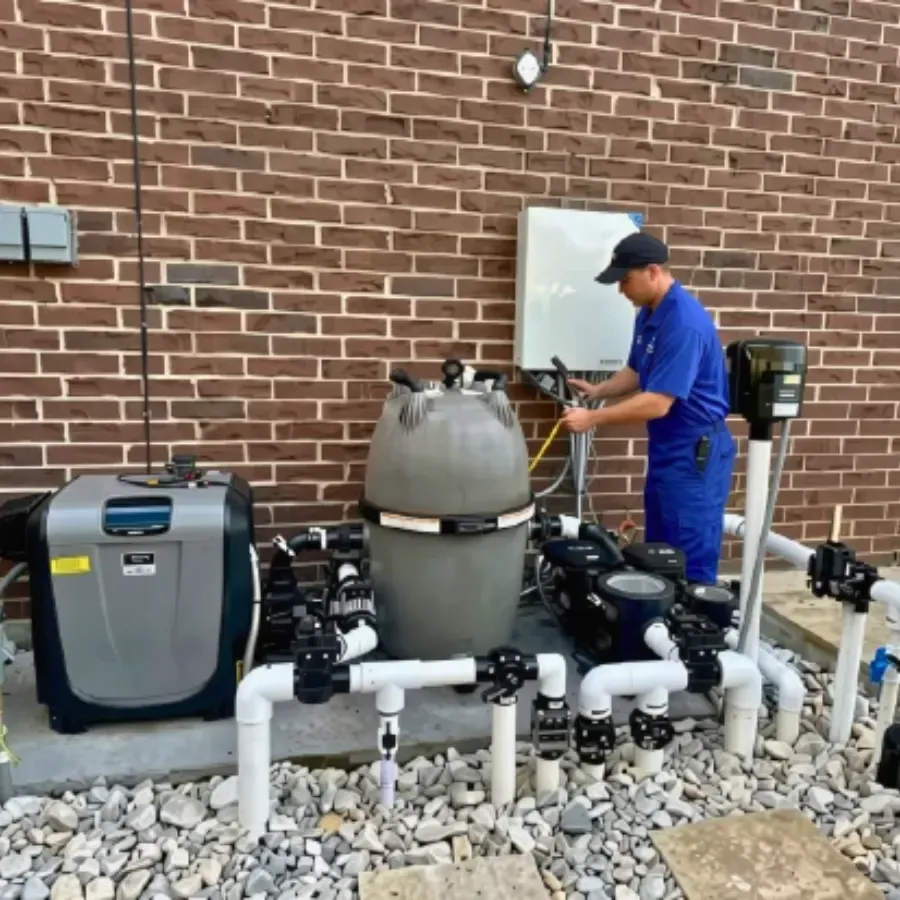
A pool upgrade should solve a problem you have. It might be high power bills, chemicals you tire of handling, controls that need your hands or lights that no longer work. This guide covers five common upgrades: salt systems, automation, LED lighting, variable-speed pumps and timers. It also explains a federal rule on pool pump motors.
It gives general information. Marina Pool Services does not publish prices, so this guide does not estimate what any upgrade costs. Marina quotes each job. Start with the question: what do you want the upgrade to do?
Which pool upgrades are worth considering?
Five upgrades come up most often: a salt chlorine generator, automation, a variable-speed pump, a timer or energy control, and new lighting. Each one fits a different goal. The table below matches goals to upgrades.
| Goal | Upgrade to consider | Marina service page |
|---|---|---|
| Handle less chlorine and get softer-feeling water | Salt chlorine generator | Salt water system installation |
| Control equipment from one panel or an app | Pool automation | Pool automation |
| Cut pump run time and power use | Timer or energy control | Timer installation |
| Cut power use from the pump | Variable-speed pump | Pump repair and installation |
| Better light, color, or replace failed lights | LED or new pool lighting | Lighting solutions |
| Protect equipment in a freeze | Freeze guard | Freeze Guard |
If you are not sure what you need, an equipment inspection shows what you have and what condition it is in. Marina lists inspection of pumps, filters, heaters, valves, plumbing connections, timers and controls. Marina services and installs Hayward, Pentair, Jandy and Raypak equipment.
What does a saltwater system do?
A saltwater system makes chlorine from salt dissolved in the pool. A salt chlorine generator has a control box and a salt cell. Water flows through the cell, and the cell turns salt into chlorine. You add salt to the pool and the system makes the chlorine.
A salt pool is still a chlorine pool. The sanitizer is still chlorine. It just comes from the cell instead of from tablets, liquid or powder you add.
This matters for expectations. Marina’s salt water page says “Salt water does not mean a pool is maintenance-free.” You still need to:
- Test the water on a regular schedule.
- Keep pH and total alkalinity in range.
- Keep the salt level where your system’s manual says.
- Check and clean the cell as the manual directs.
- Watch cyanuric acid, also called stabilizer.
Swim University says salt pools do better with a higher stabilizer level of 60 to 80 ppm. It says standard outdoor chlorine pools need 30 to 50 ppm. It also says free chlorine should sit near 7.5 percent of the stabilizer level. Different sources give different advice, so follow the manual for your system and ask your pool pro.
The CDC sets a baseline for safe water in any pool. CDC recommends pH 7.0 to 7.8 and a chlorine concentration of at least 1 ppm in pools. If the pool uses cyanuric acid, CDC says to keep at least 2 ppm. CDC also says to test chlorine and pH at least twice per day. That is a public health benchmark. A home pool owner decides how often to test, and many rely on weekly service plus their own checks.
For a full side-by-side comparison, read saltwater vs chlorine pools in Texas.
Should I convert my pool to salt?
Convert if you want a steadier chlorine source and you accept that the pool still needs care. A conversion makes less sense if your equipment is old and failing, or if your pool surfaces and fittings need a closer look first. A pro should check before you commit.
Think through these points.
| Question | Why it matters |
|---|---|
| How old is the pump, filter and plumbing? | The salt cell needs good flow. Failing equipment should be fixed first. |
| What are the surfaces and metal fittings like? | Salt water can be harder on some materials. Ask your pro about your pool. |
| Do you have a Hayward, Pentair, Jandy or Raypak setup? | Compatibility matters when choosing a system. |
| Who will test and balance the water? | Salt pools still need regular testing. |
| Is the cell easy to reach and clean? | Cells need periodic checks. |
Marina’s salt water page covers conversion of an existing pool and service of an existing salt chlorine generator. Its listed work includes salt system installation, inspection and service, and troubleshooting. See the glossary for salt system conversion.
If your salt system stops making chlorine, the first checks are the cell, the salt level and the flow. A cell can become covered with scale, and a low or high salt level can shut a system down. Your manual lists the codes for your model. A pro can test and replace parts. Marina offers equipment repair for these problems.
What does pool automation control?
Pool automation controls pool equipment from one panel, a remote or a phone app. It can run schedules and switch equipment on and off. See pool automation and control panel in the glossary.
A typical system can control some or all of these:
- The pump and its speeds
- Heater on and off, and the temperature setting
- Pool and spa lights
- Valves that switch between pool and spa, or that run features
- A salt chlorine generator’s output
- Freeze protection settings
What it controls depends on how the equipment is wired. Two pools with the same brand of controller may have different features.
Marina’s pool automation page lists three kinds of work: installation, configuration and troubleshooting. Its summary lists pool automation installation, smart control setup and service, and pool equipment scheduling and control.
Can I add automation to an older pool?
Often you can, but compatibility decides it. Automation needs a place to mount a power center, compatible valve actuators, compatible pumps and safe wiring. Older pumps that run at one speed may not use all the features. Your pro will check what you have.
Wiring a pool is electrical work. Do not attempt it yourself. Call a qualified pro. The pool automation buyer’s guide walks through brands, features and questions to ask.
What are the downsides of automation?
Automation adds parts that can fail, and it can hide problems. If one screen controls everything, you may stop looking at the equipment. Check the pad on a regular schedule even if the app says all is well.
It also takes setup. A bad schedule or a wrong setting wastes power or leaves the pump off when it should run. Ask your installer to explain the settings in plain words, and keep the manual.
How do LED pool lights compare?
LED lights give color options and use less power than older bulbs. They are a common choice when replacing a failed light. See LED pool light and pool light in the glossary.
Lighting is electrical work in and near water. A light sits in a niche in the pool wall, and a fault can create a shock hazard. A GFCI protects circuits, but it does not replace skilled installation. Hire a qualified pro. Do not open or repair a pool light yourself.
Marina’s pool lighting solutions page lists lighting service, lighting installation and replacement, and lighting system troubleshooting.
If you plan to add automation, ask whether the lights will connect to it. Some lights follow the controller’s color and on/off commands.
What do variable-speed pumps do?
A variable-speed pump runs at a range of speeds, and a lower speed can use far less power. See variable-speed pump and single-speed pump in the glossary.
ENERGY STAR gives the key physics. It says that “reducing pump speed by one-half allows the pump to use just one-eighth as much energy.” It also says certified in-ground pool pumps use 20 percent less energy than standard pumps, and that this saves about $50 a year. For above-ground pools, it says certified pumps use 11 percent less energy and save about $20 a year. It also says certified pumps can save up to $290 over their lifetime.
Those are ENERGY STAR estimates. Your savings depend on your pool, your run schedule and your electric rate.
| Pump type | How it runs | What to know |
|---|---|---|
| Single-speed | One speed, full power | Simple. Uses the most power per hour. |
| Two-speed | Low and high | Lower speed saves power. |
| Variable-speed | Many speeds | Needs the right settings. Often pairs with automation. |
A variable-speed pump needs correct settings. A speed set too low may not circulate or filter well. A speed set too high wastes the savings. A pro should set it up for your pool. The pool pump buyer’s guide covers sizing and features. If your pump is failing, see pump repair.
What is the federal rule on pool pump motors?
The U.S. Department of Energy (DOE) has set energy conservation standards for dedicated-purpose pool pump motors. These are the motors that drive residential and small commercial pool pumps. The final rule was published in the Federal Register on September 28, 2023, as 88 FR 66966.
Here are the dates exactly as the sources give them.
| Item | Date or scope |
|---|---|
| Published in the Federal Register | September 28, 2023 |
| Effective date of the rule | November 27, 2023 |
| Compliance required for motors under 0.5 total horsepower (THP) | On and after September 29, 2025 |
| Compliance required for motors from 0.5 THP up to under 1.15 THP | On and after September 28, 2027 |
| Compliance required for motors from 1.15 THP to 5 THP | On and after September 29, 2025 |
The DOE page says the rule excludes motors covered by other parts of the federal motor rules. The Federal Register entry says DOE found the standards would significantly conserve energy and are technologically feasible and economically justified.
Two notes on what this does and does not mean.
- The rule sets standards for motors that manufacturers make and sell. I did not find language in the DOE page or the Federal Register summary that requires owners to replace working pumps. Check the sources yourself if the point matters to you.
- The pages I read do not mention variable-speed pumps by name. They do not say how a variable-speed motor is treated. Ask your pool pro how a given pump meets the rule.
If your pump motor fails, ask your pro which replacement options are available and which meet the current standards. The dates above may affect what is on the shelf. Rules change, so check the DOE page for updates. This is not legal advice.
How do timers and energy controls help?
A timer limits how long the pump runs, and shorter run time means lower power use. ENERGY STAR says that running a pool filter only 6 hours a day versus 24 hours will reduce energy use by 75 percent. It says timers let you reduce filtration times. See pool timer.
That example shows the size of the effect. It does not mean 6 hours is right for your pool. How long a pool needs to run depends on its size, the pump, the debris load and the season. A pro can set a schedule for your pool and check the water.
Marina’s timer installation page lists timer installation and replacement, plus energy controls and equipment scheduling. See also freeze protection, since a timer should not leave the pump off during a hard freeze unless it has a freeze feature.
What about heaters and other equipment?
A heater is a different kind of upgrade, because it adds comfort and extends the swim season. It is not mainly an efficiency upgrade. Heaters come in gas and heat pump types. See gas heater and heat pump in the glossary.
Gas work needs a qualified pro. Never work on a gas line yourself. The pool heater buyer’s guide compares the types. Marina lists pool heater repair and installation.
Filters matter too. A filter that clogs or fails reduces flow, which hurts every other upgrade. See the pool filter buyer’s guide and the Marina filter service page.
For general guidance on how long parts last, see pool equipment lifespan.
In what order should I upgrade?
Upgrade in this order: fix what is failing, reduce risk, save power, then add comfort and convenience. This order protects your money, because later upgrades depend on earlier ones.
- Fix safety and leaks first. Anything electrical, anything leaking.
- Replace failing core equipment. A pump, filter or heater that is near the end of its life.
- Cut power use. A timer or variable-speed pump, if it fits your pool.
- Add control. Automation, once the equipment under it is sound.
- Add chemistry help. A salt system, if you want it.
- Add comfort. Lighting and a heater.
Some steps swap. If your pump fails, replace it with a pump that works with the automation you plan. Ask your pro to lay out a plan so each purchase fits the next one. See equipment installation for Marina’s installation page.
How do I plan an upgrade without overspending?
Plan by asking for an inspection, a written scope and a clear list of what each part does. Marina says it focuses on the condition of the equipment and the needs of your pool rather than recommending unnecessary work.
Use these questions with any pro:
- What is the problem this upgrade solves?
- What happens if I wait a year?
- Does it work with the equipment I have?
- What brand and model do you suggest, and why?
- Who does the electrical or gas work?
- Is the cost for parts and labor listed separately?
- How do I use and maintain it?
The guide to hiring a pool company in Texas explains how to compare providers. For cost background, see the DFW pool service cost guide. Marina does not publish prices. It offers free estimates for qualifying services.
What should I keep in mind about warranties and manuals?
Keep the manual, the model numbers and the install date for every part. Warranty terms come from manufacturers, and they vary. Marina’s site does not state any warranty or guarantee of its own, so ask about warranties when you request an estimate.
Take photos of the equipment pad after any upgrade. Save the settings for your timer or automation. If you ever call a pro for a problem, these records speed up the work. The pool owner’s handbook lists other records worth keeping.
Next step
To talk through which upgrade fits your pool, see Marina’s pool automation service or ask about a salt system or timer on the same call. Call (817) 896-1120 or send a request through the quote form at /contact.
Frequently asked questions
Is a saltwater pool maintenance-free?
No. A salt system makes chlorine from salt, but the pool still needs testing, balanced water and a clean salt cell. Marina Pool Services says on its salt water page that salt water does not mean a pool is maintenance-free. Salt pools also need regular checks of pH, alkalinity and stabilizer.
Can I add automation to an older pool?
Often yes, but it depends on your equipment. Automation needs compatible pumps, valves and controls, and a safe electrical setup. A pool pro should inspect your equipment first. Marina installs and services automation and works with Hayward, Pentair, Jandy and Raypak equipment.
Do I have to replace my pool pump because of the new federal rule?
The sources I read describe standards for new pool pump motors. They do not say owners must replace a working pump. The rule took effect November 27, 2023, with compliance dates in 2025 and 2027. If your pump fails, ask your pro what motor options meet the rule.
Does a variable-speed pump really save energy?
Yes. ENERGY STAR says reducing pump speed by half lets a pump use one-eighth as much energy. It estimates certified in-ground pumps use 20 percent less energy than standard pumps. Your savings depend on your pool, your run schedule and your electric rate.
How do I decide which upgrade comes first?
Start with safety and reliability, then efficiency, then comfort. Fix failing equipment first. Next, look at a pump or timer change that cuts run time. Then consider salt, automation or lighting. A pool pro can inspect the whole system and rank the options for your pool.
Are LED pool lights worth it?
They can be, mainly for color options and lower power draw than older bulbs. Lights are sealed units that sit in the pool wall, and wiring is electrical work. Hire a qualified pro for installation. Marina offers pool lighting installation and replacement.
Pool terms on this page
Sources
- U.S. Department of Energy: Dedicated-Purpose Pool Pump Motors
- Federal Register: Energy Conservation Standards for Dedicated-Purpose Pool Pump Motors (88 FR 66966)
- ENERGY STAR: Pool Pumps
- Swim University: Cyanuric Acid
- CDC: Home Pool and Hot Tub Water Treatment and Testing
- Marina Pool Services: Salt Water System Installation and Service
Written by Marina Pool Services and checked against the sources above on October 21, 2026. City rules and product guidance change, so check the linked page before you act. Follow product labels for any pool chemical.