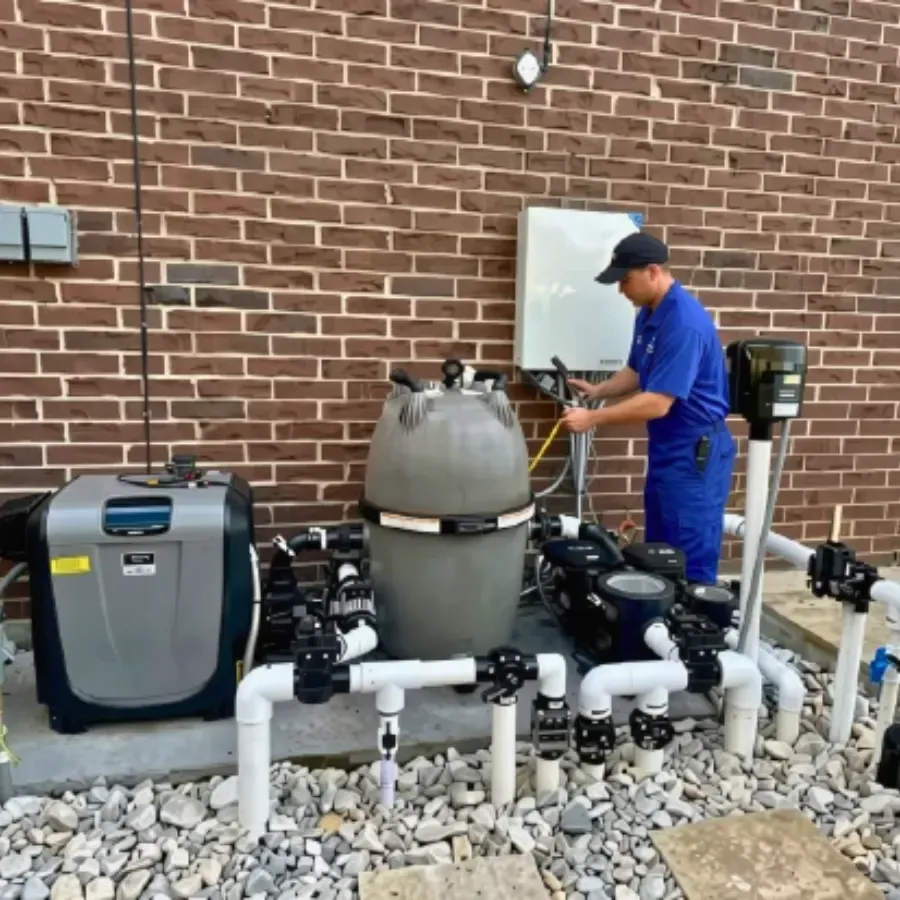
Your pool filter does a quiet, constant job. It pulls the dirt, algae and debris that the sanitizer has already killed or tangled out of the water. Picking the right type saves you time and keeps the water clear. This guide compares the three common types and gives you a maintenance table you can use.
We lean on maker and dealer pages that we opened for the numbers. Those figures are ranges, and your own equipment manual always wins. If you want help with a filter in Grapevine or nearby, see our pool filter service page.
What does a pool filter actually do?
A pool filter removes particles from the water as the pump pushes it through. Jandy puts it this way: chlorine and other sanitizers destroy bacteria, algae and other contaminants, and the filter is what removes them from the pool water.
Without a working filter, even well-balanced water turns dull and cloudy. The pool filter sits after the pump and before the heater and any salt system. Water goes in dirty and comes back out cleaner.
Filters are sorted by the size of particle they catch. The unit is the micron, one millionth of a meter. Jandy notes that a single human hair measures about 50 microns and that bacteria can be as small as 2 microns. A lower micron number means a finer filter.
What are the three types of pool filters?
The three types are sand, cartridge and diatomaceous earth (DE). Each uses a different material to trap debris, and each is cleaned in a different way.
- Sand: water passes through a tank of sand. Debris catches on the sharp edges of the sand grains. See sand filter.
- Cartridge: water passes through pleated polyester. The pleats give a large surface area. See cartridge filter.
- DE: water passes through grids coated in a powder made from crushed fossils of tiny water organisms called diatoms. See DE filter and filter grids.
Many homes in North Texas run one of these three. Which one you have often depends on when the pool was built and what the builder chose.
How do cartridge, sand and DE filters compare?
DE filters the finest, cartridge sits in the middle and sand filters the coarsest. The tradeoff is upkeep: the finer the filter, the more work it usually asks of you.
| Feature | Sand | Cartridge | DE |
|---|---|---|---|
| Finest particle (Jandy) | 20 microns and larger | About 10 microns | About 2 to 3 microns |
| How you clean it | Backwash | Remove and hose off | Backwash, add DE, clean grids |
| Water use | Backwash sends water to waste | Less water than backwashing | Backwash sends water to waste |
| Media life (Jandy) | Sand: 5 to 7 years | Cartridge: 2 to 3 years | Grids: 2 to 3 years |
| Upfront cost (Jandy) | Low | Mid | Highest |
| Effort (Jandy) | Easy | Slightly more manual work | Most maintenance |
Pinch A Penny gives slightly different numbers. It lists sand at 20 to 30 microns, cartridge at 10 to 20 and DE at 3 to 5. It also says sand media can last 5 to 10 years with good water chemistry. The gap between sources is normal. Filter ratings depend on the product and on how clean the media is.
Who should pick a sand filter?
Sand suits a homeowner who wants low upkeep and a low purchase price. Jandy calls it a budget-friendly option that needs minimal maintenance. The cost is that it filters the coarsest of the three. Jandy also notes that some people see backwashing as wasteful, since it sends water down the drain.
Who should pick a cartridge filter?
Cartridge suits someone who wants finer filtering and less water waste, and who does not mind pulling the element out and hosing it off. Jandy says cartridges perform well at low speeds, which matters if you run a variable-speed pump. You can read more about pump choices in our pool pump buyer’s guide.
Who should pick a DE filter?
DE suits a homeowner who values the clearest water and will do the extra work. Jandy says DE gives the highest water clarity, costs the most and needs the most maintenance. If you are not sure you will keep up with it, a cartridge or sand filter is the safer pick.
How do you maintain each filter type?
You clean each type when the pressure gauge says so. Jandy tells owners that the pressure gauge on a sand or DE tank signals when it is time to backwash. Pinch A Penny gives a working rule of about 10 psi over the normal operating level for all three types.
Use this table as a routine. Always follow your own filter’s manual first.
| Task | Sand | Cartridge | DE |
|---|---|---|---|
| Note clean pressure | Write down the gauge reading after a fresh clean | Same | Same |
| Routine cleaning trigger | Gauge rises about 10 psi over normal (Pinch A Penny) | Same rise | Same rise |
| Routine cleaning | Backwash | Pull the cartridge, spray it clean | Backwash, then add new DE through the skimmer |
| Deeper cleaning | Replace sand at 5 to 7 years (Jandy) | Deep clean 1 to 2 times a year (Jandy) | Hose and soak the grids once a year as needed (Jandy) |
| Replace | Sand media | Cartridge every 2 to 3 years (Jandy) | Grids every 2 to 3 years (Jandy) |
| Watch for | Pressure that jumps back fast | Torn or flattened pleats | DE powder in the pool |
Marina Pool Services covers filter work. Its service page lists cartridge filter cleaning, DE filter cleaning and backwashing, and filter replacement and installation. Weekly service also includes backwashing filters as needed. Read more on the weekly pool service page.
Why does water pressure matter so much?
Pressure tells you how clogged the filter is. As trapped debris builds up, it restricts flow and raises the pressure inside the tank, as Jandy describes for sand filters. A clogged filter also makes the pump work harder.
A gauge that reads high right after cleaning can point to other issues. The cause may be a worn cartridge, channeled sand, or a problem somewhere else in the system. That is a good time for a pro to look.
What is a multiport valve?
A multiport valve is the dial on top of many sand and DE filters. It sets the flow for filter, backwash, rinse, waste and other modes. Jandy sells multiport and slide valve kits for its sand and DE filters. If the valve leaks or will not turn smoothly, the filter cannot be cleaned properly.
What are the safety notes for filter work?
Wear a dust mask when you handle DE powder. Jandy warns that the powder can be harmful if inhaled. Also keep the pump off before you open any filter tank, and follow the manual.
Pool chemicals deserve the same care. The CDC says to keep chemicals in their original, labeled containers, store each one separately and use appropriate protective gear. See the CDC pool chemical safety page for the full list. Filter cleaning solutions are chemicals too, so read each label.
Any filter job that involves the pump motor, wiring or a power center is electrical work. Call a qualified pro for that.
How big should the filter be?
The filter must match the pool and the pump. Jandy stresses that whichever type you choose, you need to select a filter sized correctly for your pool. An undersized filter clogs fast and struggles during heavy debris weeks. An oversized one may add cost without much benefit.
Size is only part of the picture. Flow rate, pipe size and the pump all play a role. The pool pump buyer’s guide covers the pump side. If you are weighing a swap, ask a pro to check the whole circuit first.
Which brands does Marina work on?
Marina Pool Services states that it services and installs equipment from Hayward, Pentair, Jandy and Raypak. The filters in this guide come from the Jandy and Pinch A Penny pages we opened. Check your own maker’s pages for exact figures, because they differ by model.
Each maker publishes its own cleaning steps and pressure limits. Use the manual for your exact model. If you do not have it, a pool pro can usually look up the model number on the label.
When is it time to replace a filter instead of cleaning it?
Replace the filter or its media when cleaning no longer restores normal pressure and clear water. Common signs include a cartridge with torn or flattened pleats, sand that has clumped or channeled, and DE grids with damaged fabric.
Age is a guide. Jandy’s figures give you a rough clock: sand around 5 to 7 years, cartridges and DE grids around 2 to 3 years. Real life depends on debris, run time and water chemistry. Our pool equipment lifespan guide goes deeper on replacement timing.
If water keeps turning cloudy or green even though the chemistry is right, the filter is a prime suspect. Our green pool cleanup guide walks through that case.
What questions should you ask before you buy?
Ask four plain questions before you choose a filter. They keep the decision tied to your yard, not to a sales page.
- How much debris does my pool see? Trees, pets and windy weeks raise the load.
- How much upkeep will I really do? Be honest. A DE filter that is ignored performs worse than a sand filter that is kept up.
- Does my pump and plumbing fit this filter? Flow rate and pipe size matter.
- What does my equipment manual allow? Makers set their own pressure limits and cleaning steps.
If you cannot answer the third question, that is the moment to ask for an equipment inspection. A pro can look at the whole system before you spend money on a new tank.
Next step
If you want a pro to look at your filter, see our pool filter service page. Call Marina Pool Services at (817) 896-1120 or use the quote form at /contact. Marina quotes each job.
Frequently asked questions
Which pool filter is best for a North Texas backyard pool?
No single type wins for every pool. Sand is the easiest to run. Cartridge catches finer debris and wastes less water. DE gives the clearest water but takes the most work. Match the filter to your pool size, your debris load and how much upkeep you will do. A pool pro can check what your system supports.
How do I know when to clean my pool filter?
Watch the pressure gauge on the filter. Note the reading when the filter is clean. When the gauge climbs about 8 to 10 psi above that clean reading, it is time to backwash a sand or DE filter or to rinse a cartridge. Check your filter's manual, because makers give their own limits.
Can I switch from a sand filter to a cartridge filter?
Often yes, but the swap involves the tank, the plumbing connections and the pump. A cartridge filter has no backwash valve, so the plumbing changes. Flow rate matters too. Have a pool pro check the pump and pipe size before you buy a new filter tank.
Do DE filters need special care?
Yes. After each backwash you add fresh DE powder, and the grids need a deeper cleaning from time to time. Jandy warns that DE powder can be harmful if inhaled, so wear a mask. Some places also limit how you may dispose of used DE, so check local rules.
How long do pool filter cartridges and sand last?
Jandy states that sand lasts about 5 to 7 years and cartridges need replacing every 2 to 3 years. Pinch A Penny puts sand media at 5 to 10 years with good water chemistry. Real life varies with debris, run time and chemistry, so treat these as ranges.
Does a dirty filter cause green water?
It can contribute. Sanitizer kills algae and bacteria, but the filter is what removes them from the water, as Jandy explains. A clogged or worn filter lets cloudy or green water linger. Cleaning the filter is a standard step when you clear a green pool.
Pool terms on this page
Sources
- Jandy: Pool Filters (sand, cartridge and DE)
- Pinch A Penny: Sand, Cartridge or DE Filters?
- CDC: Pool Chemical Safety
Written by Marina Pool Services and checked against the sources above on October 21, 2026. City rules and product guidance change, so check the linked page before you act. Follow product labels for any pool chemical.