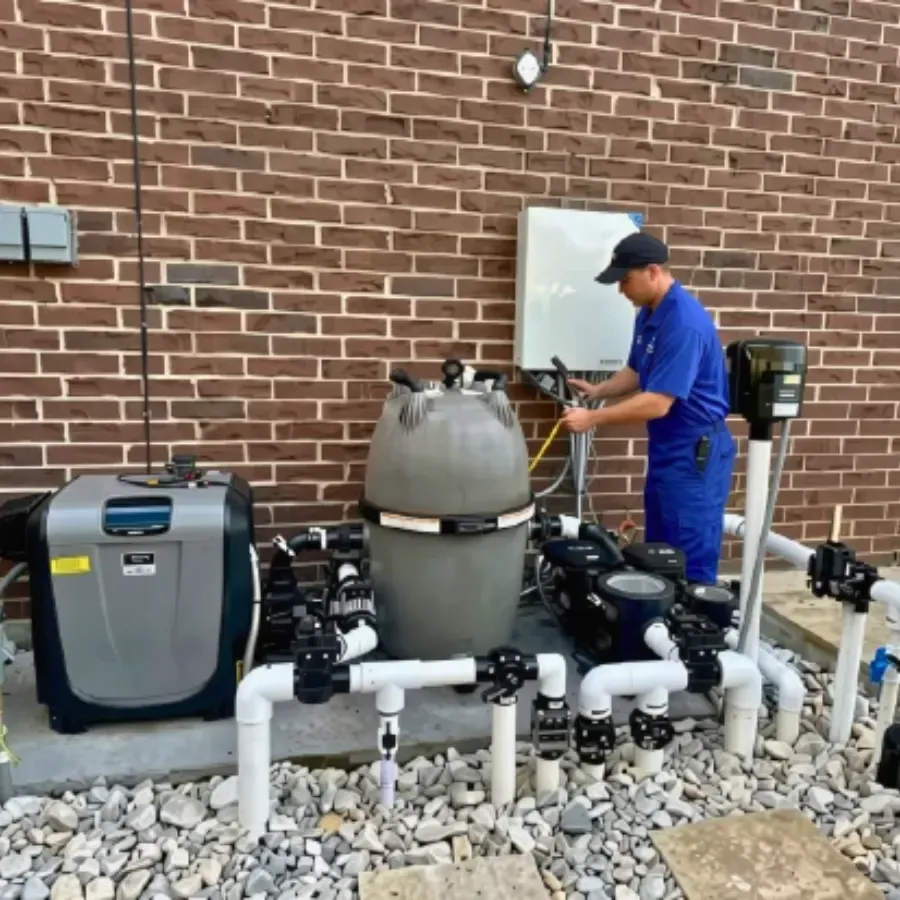
Pool equipment does not come with an expiration date. Makers print a warranty, not a lifespan. So when someone gives you a number of years, ask who said it and what they sell.
This guide gathers the ranges I could open from builders, dealers and manufacturers. It marks where a number comes from a dealer and where no source gives a number at all. Use it as a schedule for asking questions, not as a countdown.
How long should pool equipment last?
Most main pieces of pool equipment run for roughly 7 to 12 years, but the range is wide and the sources are not official. One builder’s lifespan page lists pumps at 8 to 12 years, heaters at 7 to 10 years and salt cells at 3 to 7 years. That page is marketing content from a pool company in Delaware, so read its numbers as the company’s own estimates.
Makers say less. ENERGY STAR’s pool pump page does not state a pump lifespan. It says variable speed pumps “last longer” than conventional ones but gives no number. Hayward’s warranty page lists warranty periods, not expected life. Where I could not find a source, the table below says “varies” and gives the reason.
| Equipment | Range found | Source type | What changes it |
|---|---|---|---|
| Pump (complete) | 8 to 12 years | Builder estimate | Run time, heat, clean baskets, air leaks |
| Pump motor alone | Varies | No source gave a number | Bearings, heat, power quality, water in the motor |
| Sand filter media | 5 to 7 years | Dealer listing | Debris load, backwash habits, water balance |
| Cartridge filter element | 2 to 4 years | Builder estimate | Debris, cleaning method, how often it is rinsed |
| DE filter | 10 years or more | Builder estimate | Grid care, DE handling, pressure |
| Gas or electric heater | 7 to 10 years | Builder estimate | Chemistry, run hours, freeze exposure |
| Salt cell | 3 to 5 or 3 to 7 years | Dealer and builder | Scale, cleaning, system size, runtime |
| LED pool light | Up to 20 years | Builder estimate | Niche seal, power, water ingress |
| Halogen pool light | 3 to 5 years | Builder estimate | Bulb hours, seal condition |
| Automation and controls | Varies | No source gave a number | Surge exposure, weather, sun, age of parts |
| Timers and valves | Varies | No source gave a number | Use, heat, sun, wear on moving parts |
| Plumbing | Varies | No source gave a number | Pipe type, ground movement, freezes |
Ranges overlap and sources disagree. Your yard, your water and your run time will move your own number.
Why do manufacturers not publish lifespans?
A manufacturer cannot promise a lifespan because it does not control how the part is used. It does publish a warranty, which is a promise about defects over a set time. That is a different thing.
Hayward’s warranty page shows how much terms can differ by part and by how you buy it. It lists standard residential salt cells at 3 years of parts coverage when bought individually, and a different “W” cell line at 1 year. It lists replacement pump motors at 1 year of parts. It lists some control accessories at 1 year when bought alone and 3 years when part of an original system. The page itself notes that its tables are laid out in a way that is hard to read and tells you to confirm terms in the current warranty documents.
So a warranty tells you what a maker will cover under its conditions. It is not an estimate of how long your pump will run.
Which parts wear out first?
Wear items go first. These parts are meant to be replaced during the life of the pool.
- Baskets, o-rings and lids. Hayward’s warranty page lists baskets, o-rings and pump seals as covered for manufacturing defects only. They wear with use.
- Filter media. Hayward lists cartridges, fingers, grids, o-rings and pleated elements as normal wear items. Sand also wears, and EPOOLSUPPLY says to replace it “typically every 5 to 7 years, or sooner if pressure rises rapidly between backwashes.”
- Salt cells. Inyo Pools says “on average your salt cell is going to last three to five years.” It says oversizing the system lengthens cell life, and that you should keep a cleaning schedule, about monthly, instead of waiting for the inspect-cell light. It also warns that scale is bad for the cell.
- Pump shaft seals and bearings. These are common reasons a pump gets loud or leaks. A pro can tell you whether the pump is worth repairing.
A pump basket or o-ring costs little to replace. A tired pool pump is a bigger decision. A worn sand filter is a medium one. Sort them by what each part does.
What replacement schedule makes sense?
Use a check-up schedule, not a replace-by-date schedule. Inspect on a fixed cycle, then replace what the inspection finds. Here is a plain schedule you can adapt.
| When | What to check |
|---|---|
| Every visit or week | Baskets empty, filter gauge reading, no new noise, no drips |
| Each month | Salt cell if you have one, lid o-ring, hoses and fittings |
| Each spring | Pump, filter, heater start-up, timer settings, lights, controls |
| Before freezes | Freeze protection settings and sensors, exposed pipes, drain points |
| After a freeze or storm | Look for cracks, leaks, tripped breakers, water where it should not be |
| Every 3 to 5 years | Full equipment inspection, filter media check, seal and bearing check |
| Each year in the 7 to 12 year zone | Ask whether pump, heater or cells are worth keeping |
For gauge readings, note the pressure when the filter is clean. A climb above that reading is your sign to backwash a sand filter or rinse a cartridge, and a gauge that will not drop after a backwash points to tired sand. Follow your own manual, because makers give their own limits.
Electrical and gas work has a rule of its own. If a part needs wiring or a gas line, call a qualified pro. This guide gives no wiring steps.
How do I know a part is failing?
Watch for signs before the calendar tells you. These are the ones that matter.
| Part | Sign | What it may mean |
|---|---|---|
| Pump | Loud grinding or screeching | Worn motor bearings |
| Pump | Air bubbles or loss of prime | Air leak or a worn seal or o-ring |
| Pump | Trips the breaker or will not start | Motor or power problem, call a pro |
| Filter | Pressure stays high after backwash | Tired sand or a dirty cartridge |
| Filter | Cloudy water with normal chemistry | Worn media or channeling |
| Heater | Short cycling, no heat, water leaks | Several causes, needs a pro |
| Salt cell | Low-salt or inspect-cell warnings | Scale or a worn cell |
| Controls | Random resets, dead buttons | Failing board or relay, needs a pro |
| Lights | Flicker, water in the fixture | Seal failure, call a pro |
One sign is a reason to look. A pattern of signs on the same part is a reason to plan a replacement.
When is replacing better than repairing?
Replace when repair costs keep coming back, when the part is unsafe, or when a newer part saves you real money. Repair when the fault is small and the rest of the part is sound.
Use these tests.
- Is the fault cheap and clear? A worn o-ring or a basket is a repair.
- Has the same part failed twice? A second repair in a short time points to a bigger problem.
- Is the part also old? A repair on an old part may only buy a little time.
- Is it a safety issue? Missing bonding, a failed GFCI or a broken drain cover is not something to wait on.
- Would a newer part save money? Ask for numbers on your pool, not on a brochure.
On that last test, ENERGY STAR says certified pool pumps use 20 percent less energy than standard pumps for in-ground pools, about $50 saved a year, and can pay for themselves in under two years. It also says that reducing pump speed by one half lets the pump use one eighth as much energy. The same page says a pool timer that cuts the filter run from 24 hours to 6 saves 75 percent of energy use. Those are the agency’s figures, and the page is not consistent: the contractor section cites a 70 percent saving. Treat them as direction, then ask for numbers for your own pool. A variable speed pump is the usual upgrade, and our pool pump buyer’s guide explains the choice.
Does North Texas shorten equipment life?
Probably in some ways, but I found no source that measures it. I cannot give a number for how much Texas heat, sun or freezes cut equipment life. Here is what the sources do say.
- Hayward’s knowledge base says its controller’s freeze protection is normally adequate for areas with infrequent freezing that does not dip far below 32 degrees Fahrenheit. For other conditions it says the pool should be shut down per normal winter procedures.
- Sun and heat are real stresses on exposed pipes, timers and covers, but I did not open a source that puts a number on them.
- Freezes can crack pipes, housings and heater exchangers. Our freeze protection guide covers it, and Marina’s Freeze Guard service inspects vulnerable equipment.
So in North Texas, check freeze protection and sun-exposed parts first. That is a reasoned guess, not a measured result.
How does a home sale change the schedule?
A sale is a good time to check equipment. Texas Real Estate Commission rules make the pool an optional item for a standard home inspection. Under 22 TAC 535.233, an inspector is not required to inspect those optional systems, which include swimming pools, spas and hot tubs, unless the inspector agrees to. If an inspector does agree, the rule lists items to report, such as a single blockable main drain, missing bonding, safety barrier problems, and failed ground-fault protection. So do not assume your home inspection covered the pool equipment. Our buying a home with a pool checklist walks through the first 30 days.
What does a pool equipment inspection cover?
An equipment inspection looks at the whole system and tells you what to fix, watch or replace. Marina’s equipment inspection and diagnostics service covers pumps, filters, heaters, valves, plumbing connections, timers and controls, with repair and replacement recommendations. The goal is to look at the pool as one system, not to sell a part. Marina services Hayward, Pentair, Jandy and Raypak equipment. We quote each job.
Ask for the findings in plain words. For each item you want to know what it is, what shape it is in, what could go wrong and what the choices are. Our equipment inspection page explains the service, and the equipment repair page covers fixes. If you want a diagnostic fee explained before you book, ask, because terms differ by company.
Next step
If your equipment is in the 7 to 12 year zone or is making new noises, book an equipment inspection. Call (817) 896-1120 or use the quote form at /contact.
Frequently asked questions
How long does a pool pump last?
One builder puts pumps at 8 to 12 years. I found no maker figure, so treat it as a range. Run time, heat, clean baskets and good water flow all change the result. Noise, leaks and a motor that trips the breaker are the real cues.
How long does a pool heater last?
One builder lists heaters at 7 to 10 years. No heater maker I opened states a lifespan. Water chemistry, how often it runs and how well it is protected from freezes all matter. A heater that short-cycles, will not light or leaks from the exchanger needs a pro to look at it.
How often should I replace pool filter sand?
Dealers say about every 5 to 7 years, or sooner if pressure rises quickly between backwashes. Sand wears and clumps over time, and water can channel through it. If the gauge does not drop after a backwash, the sand may be done. A pro can confirm before you buy new media.
How long do salt cells last?
Dealer and builder sources give 3 to 5 years and 3 to 7 years. Cleaning the cell on a schedule and keeping scale down helps. Hayward's warranty page lists 3 years of parts coverage for standard residential cells bought individually. Warranty is not lifespan, but it hints at what makers expect.
Is it worth replacing a pump with a variable speed pump?
ENERGY STAR says certified pumps use about 20 percent less energy than standard in-ground pumps, a saving of about $50 a year, and can pay for themselves in under 2 years on its figures. Your savings depend on your pump now, your run time and your electric rate. Ask for numbers on your own pool.
Should I replace everything at once?
Usually not. Replace what has failed or is clearly failing. Treat age as a reason to inspect, not an order to replace. An inspection looks at the whole system and tells you which parts are worth fixing and which are worth replacing. That keeps you from paying for work you do not need.
Pool terms on this page
Sources
- ENERGY STAR: Pool Pumps
- Hayward: Warranty resources
- Ashton Pools by Design: The Lifespan of Pool System Components
- EPOOLSUPPLY: Pentair Sand Dollar SD35 filter
- Inyo Pools: How Long Does a Swimming Pool Salt Cell Last
- Hayward: Do Hayward controls provide freeze protection?
- Texas Real Estate Commission rule: 22 TAC 535.233, optional systems
Written by Marina Pool Services and checked against the sources above on October 21, 2026. City rules and product guidance change, so check the linked page before you act. Follow product labels for any pool chemical.