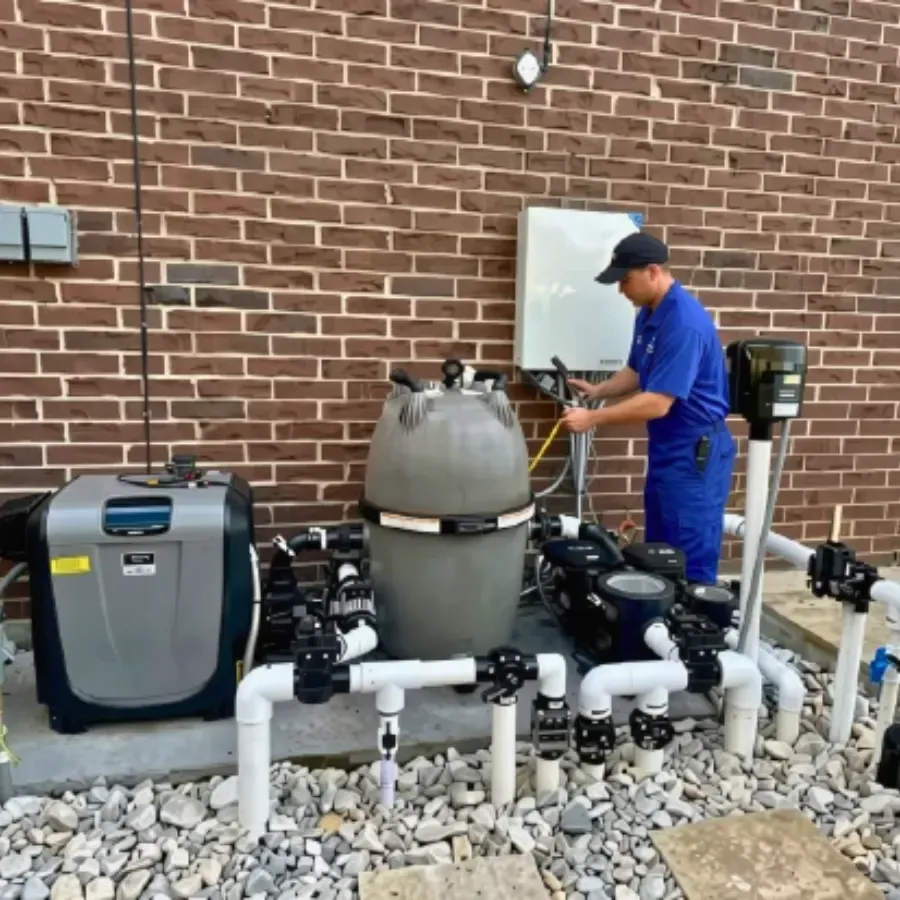
Freeze protection keeps a pool’s water moving and its equipment safe when the air drops below freezing. In North Texas, this matters less often than in other states. But when a hard freeze does arrive, it can crack pumps, filters, heaters and pipes in one night.
This guide covers how freeze protection works, what to do before a cold front, what can freeze and what to do afterward. It also explains when closing a pool makes sense. It follows published guidance from Pentair, the National Weather Service and NOAA. Your equipment manual always comes first, because settings differ by brand and model.
Why does a Texas freeze matter for a pool?
A Texas freeze matters because ice expands, and pool equipment holds water that cannot expand without breaking something. Pumps, filters, heaters and the pipes between them are the usual victims. A freeze that lasts days is far worse than a single cold night.
February 2021 shows how bad it can get. The National Weather Service in Fort Worth reports that the temperature at DFW Airport stayed at or below freezing for 139 hours in a row, from 5 pm on February 13 to noon on February 19. It also reports a low of -2 F at DFW on February 16, 2021, and 5.0 inches of snow at DFW Airport.
NOAA’s National Centers for Environmental Information (NCEI) calls it “the coldest winter storm for Texas since December 1989.” It says nearly 10 million people lost power at the peak. It also notes that water pipes burst across the state.
Most winters are nothing like that. Many winters bring only a few nights near freezing. The danger is that you cannot tell in October which kind of winter is coming. A plan you set up now costs little compared with a repair after a hard freeze.
| Event | What the source reports | Source |
|---|---|---|
| Hours at or below freezing at DFW | 139 hours, Feb 13 to Feb 19, 2021 | NWS Fort Worth |
| Lowest temperature at DFW | -2 F on Feb 16, 2021 | NWS Fort Worth |
| DFW Airport event snowfall | 5.0 inches | NWS Fort Worth |
| People without power at the peak | Nearly 10 million | NOAA NCEI |
| Length of the freeze across Texas | About 9 days | NOAA NCEI |
What is the short answer on running a pool pump in a freeze?
The short answer is that moving water is harder to freeze, so most freeze plans keep the pump and equipment running while it is below freezing. Pentair’s guidance says that without automation you should run equipment continuously until temperatures recover. With automation, Pentair says the system can keep equipment running until normal temperatures return.
Pentair also says that if freezing temperatures are short-lived, you can turn on freeze protection in your automation system. And if temperatures will drop to 45 degrees Fahrenheit or lower, Pentair says to consider a full closure.
This guide does not give one “run the pump below X degrees” rule. Settings depend on your equipment, your controller and your local conditions. Read the manual for your pump, controller and heater. If you are not sure, ask a pool pro before the cold front arrives.
How does a freeze guard work?
A freeze guard watches air temperature and starts your equipment before water in the pipes can freeze. It is a sensor, or a setting inside your automation, that tells the pump to run when the air gets cold. See freeze guard and freeze sensor in the glossary.
There are two common types.
- A freeze sensor on a controller or power center. A small sensor reads air temperature. When it falls to a set point, the controller starts the pump. The sensor must sit where it reads the real outdoor air.
- A freeze protection setting in pool automation. Modern pool automation systems often include a freeze mode. Pentair notes that automation can keep equipment running until normal temperatures return.
A freeze guard has three weak points.
- Setup. It must be turned on and set to a sensible trigger. A sensor that was never wired, or was set wrongly, does nothing.
- Power. It needs electricity. Without power, the pump cannot run.
- Water flow. Running a pump with a blocked line, a closed valve or low water can damage the pump. Make sure water can flow before the cold arrives.
Marina Pool Services offers Freeze Guard service. Its service page lists freeze protection for pool equipment, winterization service and inspection of vulnerable equipment. A pro can check that your sensor is placed well, that the settings fit your gear and that water flows freely.
What should I do before a cold front?
Before a cold front, confirm your freeze setting works, check power and water level, and protect exposed parts. Start two or three days ahead if you can. Pool supply stores and pros get busy fast when a forecast turns cold.
Use this checklist.
| Task | Why it matters | Who does it |
|---|---|---|
| Find your freeze setting in the controller or automation | A setting that is off protects nothing | You, or a pool pro |
| Check the freeze sensor location and condition | It must read outdoor air | Pool pro |
| Confirm the pool water level is normal | A pump that runs low on water can be damaged | You |
| Clear the skimmer and pump baskets | Blocked flow can stall a running pump | You |
| Look at exposed pipes, valves and the filter | These are the parts that crack | You, then a pro if unsure |
| Test the GFCI outlet or breaker for the equipment | A tripped breaker stops the pump | You, or an electrician |
| Remove cleaners and other removable accessories | Pentair lists removing cleaners, booster pumps and detachable accessories before closure | You, or a pool pro |
| Balance the water and brush the walls | Pentair says to shock and stabilize before winterization chemicals, and to brush walls to cut algae | You, or a pool pro |
Pentair also advises you to call a pool professional about what to do before temperatures affect your equipment. And it says to keep a winter cover ready once a pro has assessed the pool.
Two cautions apply. Do not do electrical work yourself. If a breaker will not stay on or an outlet looks wet or burned, call a qualified electrician. And do not drain the pool. Draining the pool itself can cause damage, and any draining of equipment lines is a pro’s job.
Do I need to close my pool in North Texas?
Most North Texas owners do not need a full closure. Most keep the pool open and use freeze protection. A full closure makes more sense if you expect a long cold spell, or if you do not plan to use the pool for months.
Pentair says to consider a full closure when temperatures will drop to 45 degrees Fahrenheit or lower. If a winter storm is coming and you cannot close in time, Pentair says to keep automation, filtration and the pump running while you wait for a pro.
Here is a plain way to decide.
| Your situation | A reasonable approach |
|---|---|
| A few nights near freezing, working freeze guard | Keep the pool open with freeze protection on |
| A long hard freeze in the forecast, working freeze guard | Keep equipment running, watch power and call a pro early |
| Power outage likely with a hard freeze | Ask a pro about extra protection for equipment |
| House vacant or pool unused all winter | Ask a pro whether winterization or a pool closing fits |
Marina’s site lists winterization as part of its Freeze Guard page. It does not list pool opening and closing as a separate service. For a closure, ask Marina what it can do for your pool when you call.
What can freeze on a pool?
Anything that holds water and cannot flex can freeze and crack. The parts below are the common ones.
| Part | What happens in a freeze | Warning signs afterward |
|---|---|---|
| Pool pump housing and fittings | Ice cracks the housing or lid, or breaks unions | Water leaks at the pump, air in the system |
| Pool filter | Ice cracks the tank, valve or gauge | Leaks, a cracked valve, a broken pressure gauge |
| Pool heater | Ice damages the heat exchanger and fittings | Water under the heater, no heat |
| Pipes and unions | Ice splits PVC or breaks fittings | Wet ground, falling water level, loud air in lines |
| Valves and check valves | Ice cracks valve bodies | Valve will not turn, leak at the valve |
| Salt cell and flow switch | Ice cracks clear housing | Cracks, leaks, no chlorine output |
| Pool lights and wiring | Water gets where it should not | Tripped GFCI, lights that fail |
The pump is often the first part to fail. It sits low, is exposed and holds water in its housing. Pools with the equipment out in the open, without a cover or windbreak, are more exposed than pools with the equipment tucked against a wall.
What should I do if something froze?
If something froze, shut off power at the breaker first, stay safe and do not restart equipment you think is cracked. Then call a pro to inspect the system. Restarting a cracked pump can spray water around live wiring and can burn the motor out.
Follow these steps.
- Turn off the power to the equipment at the breaker. Do this only if you can reach the panel safely and the ground is dry. If the area is wet, stay away and call an electrician.
- Look from a safe distance. Check for ice, cracked housings, leaks and sagging pipes. Take photos for your records.
- Do not run the equipment. A pump, heater or salt system with a crack can fail further or leak.
- Let ice thaw naturally. Do not pour hot water on equipment or use a torch.
- Check the pool water level. A big drop can point to a pipe leak.
- Call a pool pro for an inspection. Describe what you see. A pro will test the system and recommend repairs.
- Ask your insurer what your policy covers. Some policies treat freeze damage differently. Ask before you start repairs.
Marina Pool Services repairs freeze damage. Its freeze damage repair page says it helps pool owners in Tarrant County, including Grapevine, Southlake, Keller and nearby areas. After a hard freeze, repair crews are in high demand, so call early.
Afterward, it is smart to have the full system checked. A pump may start and run, but a hidden crack in a pipe can leak for weeks. Marina also offers equipment inspection and general equipment repair.
Do timers, automation and equipment choices affect freeze risk?
Yes. Equipment that can start itself is better in a freeze than equipment that depends on you to flip a switch. A pump on a pool timer will not protect you at 3 am on its own, unless the timer includes a freeze feature. A controller with a freeze mode will.
Compare common setups.
| Setup | Freeze protection | Gap to watch |
|---|---|---|
| Manual switch, no timer | None unless you run it by hand | You must be home and awake |
| Basic timer | Runs on a schedule, not a temperature | Schedule may leave the pump off during the coldest hours |
| Timer with freeze sensor | Starts the pump when the air is cold | Sensor placement and settings |
| Automation with freeze mode | Keeps equipment running as needed | Settings, power and flow |
If your pool has no freeze protection, adding it is a smaller job than repairing a pump, a filter and plumbing. Marina offers timer installation and pool automation work. Pool automation can also add other benefits. See the pool upgrades guide for more.
What about power outages?
A freeze guard cannot run a pump without power. In a long outage during a hard freeze, a pool can lose its protection no matter how well it was set up.
NOAA reports that nearly 10 million people were without power at the peak of the February 2021 freeze. NCEI also reports that the freeze lasted nearly nine days in all. That is a strong reason to plan ahead.
You cannot control the grid. You can do a few things.
- Ask a pro in advance. Pentair’s page says to call a pool professional before temperatures affect your equipment. Ask what a pro would do if power fails at your pool.
- Know where your shutoff points are. Learn your breaker and the main water valves.
- Never run a generator indoors or near a closed garage. Carbon monoxide kills. Never power pool gear from a generator unless a qualified electrician has set up the connection.
- Keep your pro’s number handy. After the storm, call early.
This guide does not claim to have a safe do-it-yourself fix for a long outage. If one is coming, a professional can look at your exact setup.
How does winter affect water chemistry and algae?
Cold water slows algae, but it does not stop it. A pool that sits idle with poor chemistry can still turn green. Pentair advises shocking and stabilizing the water before adding winterization chemicals. And it says to brush the walls to reduce algae.
If you keep weekly service all winter, the water stays balanced and baskets stay empty. Marina’s weekly pool service covers water balance (chlorine, pH, alkalinity, calcium hardness, conditioner, and salt if applicable), emptying baskets, backwashing filters as needed, and vacuuming and brushing as needed.
Check your levels after a freeze too. Cold weather, debris and storm runoff can change the chemistry. Terms to know: pH, total alkalinity and free chlorine. The water chemistry chart lists the target ranges.
If a pool turns green after a freeze or storm, see the green pool cleanup guide. If your water is cloudy but not green, the same guide covers the causes.
What do I do the rest of the winter?
Keep watching the forecast, keep the freeze setting on and keep up basic care. Cold fronts in North Texas often arrive with little notice.
A simple winter routine:
- Check the weather each week. Look for lows near freezing, not only for the single-digit nights.
- Look at the equipment pad. Check for leaks and for puddles around the pump, filter and heater.
- Keep baskets clear. Leaves can block flow right when you need the pump to run.
- Test the water. Even in cold weather, test at least on a regular schedule or ask your pro to do it.
- Check that the freeze setting is still on. Settings can be reset after a power flicker.
For the full yearly calendar, see the North Texas pool calendar and the North Texas pool care guide. For all the basics in one place, read the pool owner’s handbook.
How much does freeze protection or freeze repair cost?
Marina Pool Services does not publish prices, and this guide does not estimate them. Costs depend on the equipment, what failed and how large the job is. Marina quotes each job. It offers free estimates for qualifying services.
If you want a general idea of repair costs in the area, the pool service cost guide for DFW explains how pricing works. For freeze protection, the Freeze Guard service page shows what Marina covers.
Which Texas cities does this apply to?
Freeze risk applies across North Texas. Marina Pool Services is based in Grapevine and serves nearby cities, including Grapevine, Southlake, Colleyville, Keller and Trophy Club. See the service areas page for the full list.
Next step
If you want your freeze protection checked before the next cold front, see Marina’s Freeze Guard service. You can call (817) 896-1120 or send a request through the quote form at /contact.
Frequently asked questions
What temperature should I run my pool pump in winter?
There is no single number that fits every pool. Pentair says to run equipment continuously until temperatures recover when a freeze is coming and you have no automation. With automation, use its freeze protection setting. Check your equipment manual or ask a pool pro for the setting that fits your system.
Does freeze protection work if the power goes out?
No. A freeze guard needs power to start your pump. If the power fails, the pump cannot move water. Outages happened widely in February 2021. If a long outage and a hard freeze are both likely, call a pool pro early about your options.
Do I need to close my pool in Texas?
Most North Texas owners keep pools open all year and use freeze protection instead. Pentair says to consider a full closure when temperatures will drop to 45 degrees Fahrenheit or lower. A closure is more likely when you expect a long, deep cold spell.
Should I drain my pool for winter?
No. Do not drain the pool itself. Water in the pool helps protect the shell, and an empty pool can be damaged. Draining or blowing out equipment lines is different work, and it belongs to a pro. Ask a pool pro before you remove any water.
What do I do if my pool equipment froze?
Turn off power at the breaker, stay clear of the equipment and look for cracks or leaks once it is safe. Do not restart a pump or heater that may be cracked. Call a pool pro to inspect it. Marina Pool Services repairs freeze damage in Grapevine and nearby cities.
Can a pool heater freeze?
Yes. A heater holds water inside its heat exchanger and plumbing, so a hard freeze can crack it. Keeping water moving through the heater during a freeze helps. A cracked heater needs a pro to inspect it before any restart.
Pool terms on this page
Sources
- National Weather Service Fort Worth: February 2021 Historic Winter Storm and Arctic Outbreak
- NOAA NCEI: The Great Texas Freeze, February 2021
- Pentair: Pool Freeze Protection
- Marina Pool Services: Freeze Guard and Winterization
Written by Marina Pool Services and checked against the sources above on October 21, 2026. City rules and product guidance change, so check the linked page before you act. Follow product labels for any pool chemical.