A North Texas pool does not have a long off season. It has a hot season, a leafy season, a few cold snaps and a spring wake-up. This calendar walks through the year and ties each month to National Weather Service numbers for Dallas Fort Worth.
Weather facts here are for DFW Airport, which is the official record for the area. Grapevine sits close, but your own yard can run warmer or colder. Treat the numbers as a guide and watch your local forecast.
What does the North Texas climate mean for a pool?
It means heat for months, a short freeze window and sudden swings. The 1991 to 2020 normals for DFW show the pattern.
| Month | Normal high (F) | Normal low (F) | Normal rain (in.) |
|---|---|---|---|
| January | 56.5 | 36.1 | 2.53 |
| February | 60.9 | 40.1 | 2.76 |
| March | 68.6 | 47.8 | 3.30 |
| April | 76.1 | 55.2 | 3.22 |
| May | 83.6 | 64.5 | 4.78 |
| June | 91.5 | 72.2 | 3.70 |
| July | 95.6 | 75.8 | 2.08 |
| August | 95.8 | 75.7 | 2.18 |
| September | 88.6 | 68.5 | 2.72 |
| October | 78.4 | 57.1 | 4.37 |
| November | 66.6 | 46.2 | 2.53 |
| December | 57.9 | 38.3 | 2.84 |
Source: NWS Fort Worth, DFW normals for 1991 to 2020. The annual rainfall normal is 37.01 inches.
Two lines on that table matter most. May has the most rain of any month at 4.78 inches, and October is next at 4.37 inches. Rain adds water, dilutes chemicals and carries in debris. July and August have the highest highs and the lowest rain.
When is the freeze window?
NWS Fort Worth lists the average first freeze at DFW as November 22 and the average last freeze as March 12. The page lists these extremes:
| Freeze fact | Date | Temperature |
|---|---|---|
| Earliest first freeze | October 22, 1898 | 31 F |
| Latest first freeze | January 4, 1972 | 21 F |
| Earliest last freeze | January 8, 2017 | 20 F |
| Latest last freeze | April 13, 1957 and 1997 | 30 F and 32 F |
The page does not say which years the averages cover, and it lists the lowest temperature on each date. So use the dates as a planning window, not a promise. A pool owner should have a freeze plan ready by late October and keep it until mid April.
What should I do in March and April?
Wake the pool up after the last freeze risk. In March, DFW’s normal high is 68.6 and the normal low is 47.8. In April, the normal high is 76.1 and the low is 55.2. Cold nights can still come, since the latest last freeze on record is April 13.
- Watch the forecast. Keep freeze protection on until the nights stay above freezing.
- Clean up first. Skim and remove leaves and debris before you start chemical work.
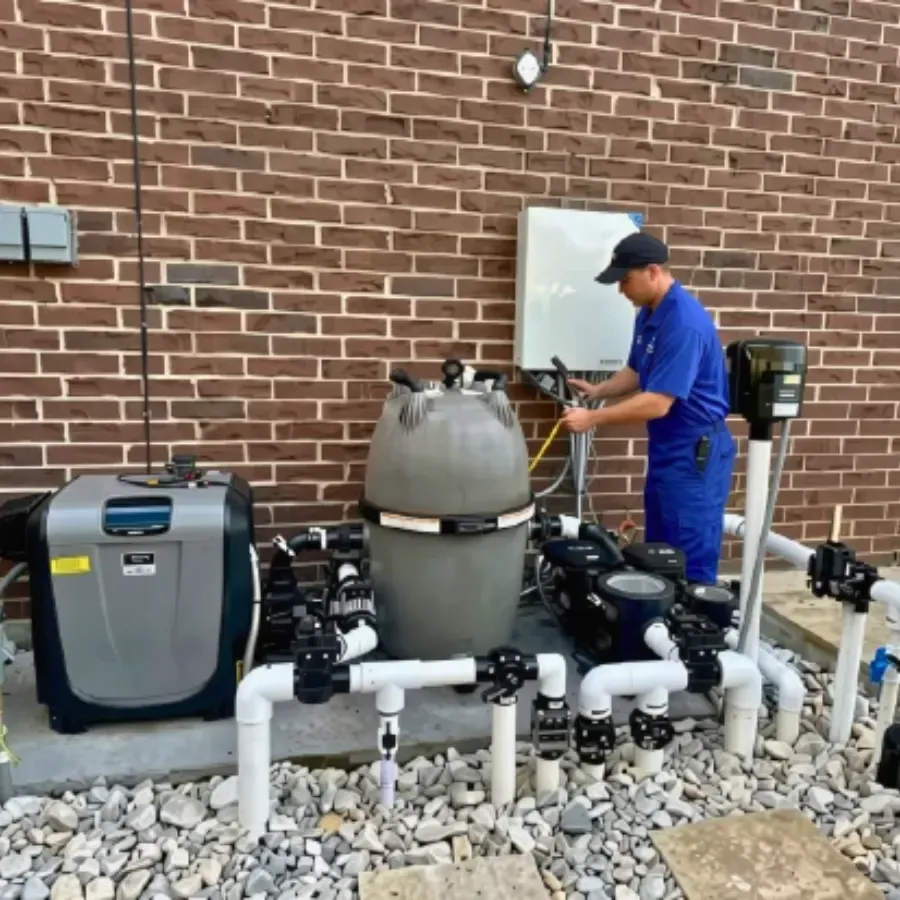
- Check the equipment pad. Look for cracks, drips, loose fittings and signs of winter damage. Our freeze damage page explains what damage can look like.
- Test the water. CDC recommends pH 7.0 to 7.8 and at least 1 ppm chlorine. Use a test kit, then adjust by the label. Our water chemistry chart lists targets.
- Clean the filter. Backwash a sand or DE filter as needed, or rinse a cartridge. Note the clean pressure reading on the gauge.
- Set the pump timer. Plan run time with the season in mind. Ask a pro about your pump, since the right run time depends on your pool.
- Do a spring startup check. A startup service in general means getting equipment and water ready for the swim season. Marina’s equipment inspection looks at pumps, filters, heaters, valves, plumbing connections, timers and controls. See equipment inspection.
If the pool has gone green over winter, our green pool guide lists the steps in order.
What should I do in May and June?
Get into a weekly routine before the heat peaks. May is the wettest month at DFW, with a normal of 4.78 inches. Storms bring runoff and debris. June highs reach a normal 91.5 degrees.
- Test after every big storm. Rain can change chlorine and pH, and runoff can bring in debris.
- Empty the skimmer and pump baskets often, since full baskets cut flow.
- Check that the heater works before you need it, if you use one.
- Look at the water level. Add water if it falls below the skimmer.
- Watch for early algae after warm, wet spells. See post-storm algae.
Weekly service covers water balance, emptying baskets, backwashing filters as needed, and vacuuming and brushing as needed. See weekly pool service in Grapevine.
What should I do in July and August?
Test more often and keep the pump running enough to circulate the water. July and August normals are 95.6 and 95.8 degrees for the high. NWS lists the average first 100 degree day at DFW as July 1 and the average last as August 27. The record is 71 days of 100 degrees or more in 2011. NWS also lists March, April and October as months that have had a 100 degree day, but the average there is near zero.
Heat and sun strain a pool in three ways. Chlorine gets used up faster. Water evaporates faster. Equipment runs hot. Here is a short summer routine.
| Task | How often |
|---|---|
| Test chlorine and pH | CDC says at least twice a day for home pools, more with heavy use |
| Empty baskets | Often, and after storms |
| Check the water level | Often, since evaporation is higher in heat |
| Brush walls and steps | Weekly or as needed |
| Check filter pressure | Weekly |
| Look at the pump and heater | Weekly, for noise, drips and heat |
| Store chemicals | Cool, dry, out of sun, separate, below 95 F per CDC |
The cyanuric acid level matters in sun, since it protects chlorine from UV light. CDC advises at least 2 ppm of chlorine when you use products with stabilizer. Do not add stabilizer products without checking the label and your test result.
If you take a trip, plan for your pool. Plan ahead if you will be away in July. Ask a pro about vacation service and check what a company actually offers before you count on it.
For safety in heat, keep the water watcher rule and keep chemical storage cool. CDC says to keep pool chemicals below 95 degrees Fahrenheit and out of direct sunlight.
What should I do in September and October?
Prepare for leaves and rain. September drops to a normal high of 88.6. October has a normal high of 78.4 and rain of 4.37 inches, the second wettest month at DFW. Leaves, seed pods and storm debris reach the water in fall.
- Skim often. Remove leaves before they sink and stain.
- Empty baskets more often. Leaf loads fill them fast and choke the pump.
- Brush and vacuum. Leaves left on the floor break down and use up chlorine.
- Check the water level and balance.
- Start your freeze plan. Test your freeze sensor and controller setting in October, before the first cold night. Read about freeze sensors and Freeze Guard.
- Inspect equipment. Fix a leak or a noisy pump now. A small problem is harder to live with in a freeze.
I did not find a source that ranks which trees drop the most debris near Grapevine, so I will not name any. Look at your own yard.
What should I do in November and December?
Be ready for the first freeze, which averages November 22 at DFW. Normal highs drop to 66.6 in November and 57.9 in December, and normal lows are 46.2 and 38.3. The average first freeze falls in the second half of November, and the earliest on record was October 22.
- Confirm freeze protection works. Many systems use a sensor that starts the pump when temperatures drop. Hayward says its controller’s freeze protection is normally adequate for areas with infrequent freezing that does not dip far below 32 degrees Fahrenheit. For other conditions, it says the pool should be shut down per normal winter procedures.
- Know where your shutoffs and drains are.
- Keep the water balanced. Cold water still needs sanitizer.
- Clear leaves before a hard freeze.
- Ask a pro whether your setup suits a deep freeze. Marina’s Freeze Guard service covers freeze protection, winterization and inspection of vulnerable equipment.
Our freeze protection guide explains the options in more depth.
What should I do in January and February?
Watch the forecast, and treat every hard freeze as an event. January normals at DFW are a high of 56.5 and a low of 36.1. February is a high of 60.9 and a low of 40.1. A normal low above freezing hides cold snaps.
The February 2021 storm shows why. NWS records DFW’s low at minus 2 degrees on February 16, 2021, and says DFW stayed at or below freezing for 139 hours from 5 pm February 13 to noon February 19. An earlier 93 hour stretch ran from February 9 to 13. The all-time DFW low is minus 8, set on February 12, 1899.
During a long freeze:
- Keep the plan active. If your system is set to run the pump in freezing weather, check that it is running.
- Check for power loss. Freeze protection needs power. If the power goes out, you may need other steps from a pro.
- Do not use the pool equipment if it looks damaged. Do not attempt electrical or gas repairs yourself.
- After the thaw, inspect. Look for cracks, leaks, tripped breakers and wet ground near the pad.
- Call a pro if you see damage. See freeze damage repair.
Your equipment manual and a pro should guide the exact freeze settings.
How do I turn this into a yearly schedule?
Use the table as a one page plan. Adjust it for your pool and your equipment.
| Months | Main goal | Key tasks |
|---|---|---|
| January to February | Stay protected | Watch the forecast, keep freeze protection on, check after each freeze |
| March to April | Wake up | Clean up, inspect equipment, test and balance water, clean the filter |
| May to June | Build the routine | Weekly care, test after storms, keep baskets empty |
| July to August | Beat the heat | Test often, watch the level, brush, check equipment |
| September to October | Handle debris | Skim, brush, empty baskets, test the freeze sensor |
| November to December | Be freeze ready | Confirm protection, know the shutoffs, clear leaves |
Some owners use a weekly service for the steady work and call a pro for the seasonal checks. Marina Pool Services is a family-owned, locally operated company based in Grapevine, with more than 20 years of combined pool experience, and it works on residential pools. We are insured through IPSSA. Our city pages, such as Grapevine pool repair, list where we work.
Next step
Set up weekly pool service in Grapevine to cover the steady work all year. Call (817) 896-1120 or use the quote form at /contact.
Frequently asked questions
When should I open my pool in North Texas?
There is no single date. DFW's average last freeze is March 12, and the latest on record is April 13. Many owners restart heavy use after the last freeze risk passes and the water warms. Check the forecast, clean up debris, test the water and inspect equipment before the first swim.
When is the first freeze in North Texas?
NWS lists the average first freeze at DFW as November 22. The earliest on record was October 22, 1898, and the latest was January 4, 1972. An average is not a promise, so watch the forecast from October and have your freeze plan ready before it gets cold.
How hot does it get in North Texas in summer?
Normal highs at DFW for 1991 to 2020 are 91.5 in June, 95.6 in July and 95.8 in August. NWS lists the average first 100 degree day as July 1 and the average last as August 27. The record is 71 days in 2011.
Do I need to winterize a pool in Texas?
It depends on your equipment and how cold it gets. Many North Texas pools run all winter with freeze protection. Hayward says its controller's freeze protection suits areas with infrequent freezing that does not dip far below 32 degrees Fahrenheit, and that other pools should shut down. Ask a pro about your setup.
How cold did it get in the February 2021 freeze?
NWS records DFW's low at minus 2 degrees Fahrenheit on February 16, 2021. DFW stayed at or below freezing for 139 hours from February 13 to 19, after another 93 hour stretch earlier that month. It is a reminder that the average dates can hide extreme events.
How often should I test pool water in summer?
CDC says to test chlorine and pH at least twice a day for a home pool, and more often with heavy use. It recommends pH 7.0 to 7.8 and at least 1 ppm chlorine, or 2 ppm with stabilizer products. Heat and sun use up chlorine faster, so test often.
Pool terms on this page
Sources
- NWS Fort Worth: DFW First and Last Freeze Dates
- NWS Fort Worth: DFW Normals, Means, and Extremes
- NWS Fort Worth: DFW 100 Degree Day Summary
- NWS Fort Worth: February 2021 Historic Winter Storm and Arctic Outbreak
- CDC: Home Pool and Hot Tub Water Treatment and Testing
- CDC: Pool Chemical Safety
- Hayward: Do Hayward controls provide freeze protection?
- ENERGY STAR: Pool Pumps
Written by Marina Pool Services and checked against the sources above on October 21, 2026. City rules and product guidance change, so check the linked page before you act. Follow product labels for any pool chemical.