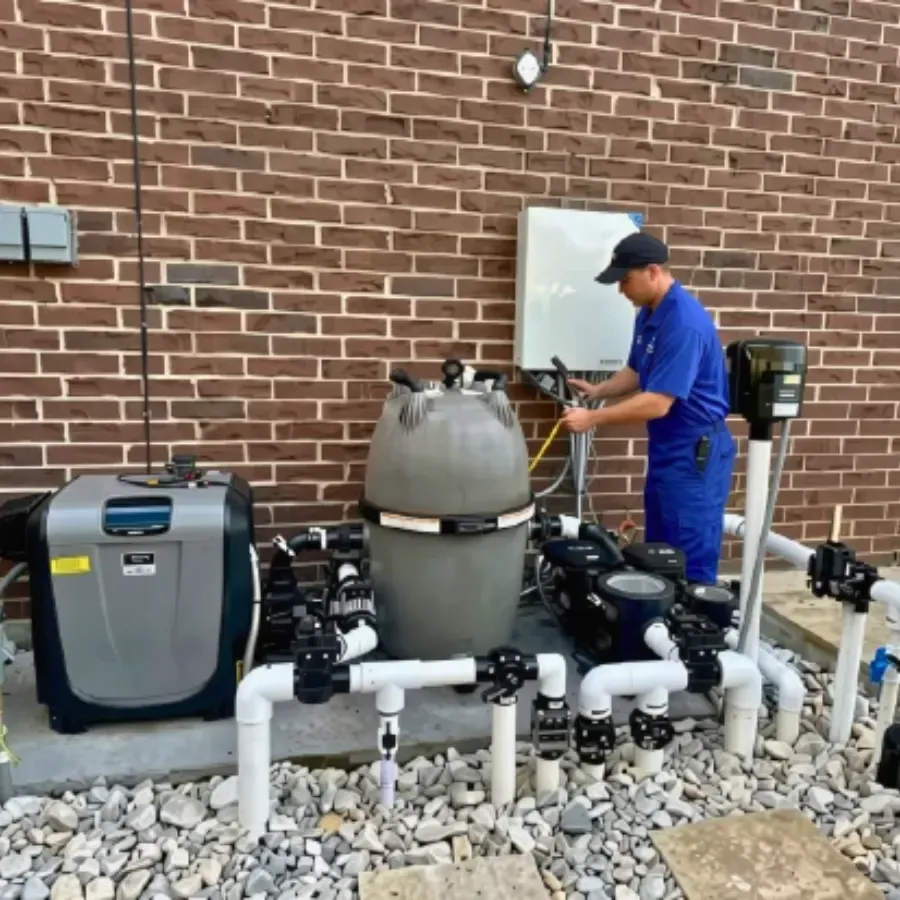
The pump is the heart of your pool. It pulls water through the skimmer and drain, pushes it through the filter and heater, and sends it back. When it fails, everything else suffers. When you choose a new one, the type matters for how much power you use and how well the rest of the equipment works.
This guide explains the three pump types, the federal efficiency rule, and how to size and shop. We do not rank brands. We used manufacturer and Department of Energy (DOE) pages that we opened. For pump repair or replacement in the Grapevine area, see our pool pump repair page.
What does a pool pump do?
A pool pump moves water so the filter, sanitizer and heater can do their jobs. Without flow, chlorine does not spread, the filter does not clean and the heater shuts off.
A pump has a wet end and a motor. The wet end holds the impeller, the basket and the lid. The motor spins the impeller. Parts that wear include the shaft seal, the motor bearings and the lid O-ring. Our pump repair page covers fault finding and fixes.
What are the three types of pool pumps?
The three types are single speed, two speed and variable speed. They differ in how many speeds the motor can run.
| Type | What it does | Main trade-off |
|---|---|---|
| Single speed pump | One speed, on or off | Simple, but always runs at full power |
| Two speed pump | A high and a low speed | You can run low for daily circulation and high when you need it |
| Variable speed pump | Many speeds, set by you or a control | Finer control and lower power use at low speed |
Pentair says single speed pumps run at one speed. It says variable speed pumps allow you to adjust the flow rate, and that they typically have three to eight preprogrammed speeds for various tasks.
Why does speed matter? A pump on low speed moves less water but uses far less power. Pentair says pumps working at lower speeds more consistently can let owners run longer without racking up energy use.
What is the DOE pool pump rule?
The DOE rule sets minimum efficiency for new dedicated-purpose pool pumps. It applies to pumps manufactured on or after July 19, 2021. DOE published the direct final rule in the Federal Register on May 26, 2017 (82 FR 24218), and the standards are written into 10 CFR 431.465.
Key points from the rule text and DOE pages:
- It covers the maker, not the owner. Pumps made or distributed in commerce must meet the standards, per DOE’s page. The pages we opened do not require owners to replace a working pump.
- It measures a score called WEF. WEF stands for weighted energy factor, in thousands of gallons moved per kilowatt hour. A higher score means a more efficient pump. The rule sets a minimum WEF by pump type and size.
- It does not name a speed. The rule text we opened sets WEF minimums. It does not say “variable speed” or “two speed.” A pump meets the rule by reaching the score.
- Which pumps it covers. DOE lists self-priming and non-self-priming pool filter pumps under 2.5 hydraulic horsepower, pressure cleaner booster pumps, and integral sand and cartridge filter pumps. It exempts waterfall pumps and filter pumps of 2.5 hydraulic horsepower or more.
- Booster pumps have their own number. The rule sets a WEF of 0.42 for pressure cleaner booster pumps.
- Timers on integral filter pumps. Integral sand and cartridge filter pumps must ship with a pool pump timer. DOE defines it as a control that turns the pump off after a run time of no more than 10 hours.
- Freeze protection defaults. A pump shipped with freeze protection controls must either ship with it off or use set defaults: an air temperature setting no higher than 40 degrees F, a run time no longer than one hour before rechecking, and a motor speed no more than half the maximum. The owner can adjust these.
- Motors have a separate rule. A later rule covers the motors themselves. It took effect November 27, 2023 (88 FR 66966). Compliance began September 29, 2025 for motors under 0.5 total horsepower and for 1.15 to 5, and begins September 28, 2027 for 0.5 to under 1.15.
DOE estimated the benefit of the 2017 pump standards at $11 billion to $24 billion in total net consumer savings, depending on the discount rate, for pumps bought from 2021 to 2050. That is a national estimate, not a figure for your pool.
What does this mean when you shop? New dedicated-purpose pumps from makers must meet the rule. Ask your dealer for the model’s WEF, and ask what it means for your pool size and plumbing. A pool pro can help read the spec sheet.
How much can a variable speed pump save?
Pentair says a variable speed pump could cut energy costs by up to 90 percent compared with a conventional single speed or two speed pump. That is a manufacturer claim, so read the fine print.
Pentair states the claim is based on a variable speed pump compared with a single speed pump running 12 hours a day. It adds that actual savings may vary with local utility rates, pool size, pump run time and pump horsepower.
How to use that:
- Treat 90 percent as a best case, not a forecast.
- Ask for an estimate with your own pump size, run hours and electric rate.
- Compare the up-front price gap against your estimated yearly savings.
- Remember that your savings depend on running the pump at lower speeds for longer.
We do not publish prices. Marina quotes each job, and a free estimate is available for qualifying services.
How do I size a pool pump?
Size the pump to your pool, your pipe and your equipment. Pentair says the pump should be appropriate to maintain proper chemistry, cleanliness and clarity, and that “bigger is not always better.” It adds that the pump needs to fit the pipe size on your pad, and that every pool is unique and needs accurate measurements.
What to gather before you shop:
- Pool volume in gallons.
- Pipe size on the suction and return sides.
- Filter type and size. See pool filter and our filter buyer’s guide.
- Extras on the same plumbing, such as a heater, salt cell, cleaner or water feature.
- Current pump model and horsepower, from its label.
Too small and the water does not turn over. Too large and you waste power, and Pentair notes that bigger is not always better. Pentair also lists a shorter pump lifetime as a result of low horsepower, so do not undersize either.
Will the pump work with my heater and salt system?
It must meet the flow needs of each device. A pump on a low speed may not move enough water to run them.
- Gas heater. Raypak lists minimum flow of 20 gallons per minute for its 206A, 25 for the 266A, 35 for the 336A and 40 for the 406A. Check your heater’s manual. Raypak also says that when the heater runs between 0 and 32 degrees F, flow (continuous pump operation) must be maintained.
- Salt system. Hayward says its AquaRite stops making chlorine when its flow switch senses no flow. It also says the filter run time should be long enough for the pool, with 8 hours for an average-size pool and more for a large one. See flow switch.
- Filter. The filter has a maximum flow rating too. Do not exceed it.
If you add a pump to an older system, our pool automation page and pool timer page cover control options. A pool timer lets you set run hours.
What should I check before I buy?
Use this checklist.
- Confirm the fault is the pump. A clogged basket, an air leak or a dirty filter can mimic a failed pump. Our equipment inspection page covers diagnosis.
- Check the pump age. See our pool equipment lifespan guide.
- Match the pipe size and mounting. Measure the unions and pad space.
- Ask for the WEF and the speed range. A wider range gives more control.
- Check controls. Decide whether it will run from a timer, from automation, or from its own keypad.
- Confirm flow for the heater and salt system. Use the minimums above.
- Plan freeze protection. Know how your pump’s freeze settings work. See our freeze guard service.
- Leave the wiring to a pro. Pumps run on high voltage and must be bonded and grounded. Call a qualified electrician or pool pro. Do not wire a pump yourself.
Which pump type is right for me?
The right pick depends on how you use the pool and what the rest of the system needs. This table helps you narrow it.
| If this is you | Lean toward |
|---|---|
| You want the simplest setup and lowest purchase price | Single speed, where the rule allows for the model you want |
| You want some savings with little programming | Two speed |
| You run a heater, salt cell, cleaner or features | Variable speed, with flow checked |
| You want fine control and the lowest running power | Variable speed |
| You are unsure | Ask a pro to review your system |
Which speed types qualify at each pump size is a question for the dealer. We did not confirm that from the rule text, so ask which models for your pool meet it.
What does Marina service?
Marina services and installs Hayward, Pentair, Jandy and Raypak equipment. For pumps, the pool pump repair page lists troubleshooting and repair, pump replacement and installation, and equipment recommendations based on your pool system. Marina does not rank brands. The right model depends on your pool.
Next step
If your pump is failing or you are planning an upgrade, see our pool pump repair page. Call (817) 896-1120 or send a request through the contact form. For a wider view of repair work, read our pool equipment repair guide.
Frequently asked questions
What is the difference between single, two and variable speed pool pumps?
A single speed pump has one speed. A two speed pump has a high and a low setting. A variable speed pump lets you choose from many speeds, and Pentair says they typically have three to eight preprogrammed speeds. Lower speeds move less water but use much less power.
Is a variable speed pool pump required by law?
Not by name. A DOE rule sets minimum efficiency for new dedicated-purpose pool pumps made on or after July 19, 2021. It is written as a performance score, called WEF, not as a speed type. Sources we opened do not say you must replace a working pump. Ask a dealer which models meet the rule.
How much can a variable speed pump save?
Pentair says up to 90 percent compared with a single speed pump running 12 hours a day. It also says actual savings vary with utility rates, pool size, run time and horsepower. Treat that as a ceiling, not a promise, and ask for your own estimate.
What size pool pump do I need?
Pentair says the pump should be appropriate to maintain chemistry, cleanliness and clarity, that bigger is not always better, and that it must fit the pipe size on your pad. Every pool is unique, so ask a pool pro to review your plumbing, filter and equipment before you buy.
Can a variable speed pump work with my heater or salt system?
Usually, but check minimum flow. Raypak lists minimum flows of 20 to 40 gallons per minute for its gas heater models. Hayward's salt system stops making chlorine if its flow switch senses no flow. Make sure your lowest working speed keeps enough flow for each device.
Should I repair or replace my pool pump?
That depends on the fault, the pump's age and the cost to repair. A worn part such as a lid O-ring is a different job from a failed motor. A technician can inspect the pump, explain the options for your system and give a written quote.
Pool terms on this page
Sources
- Department of Energy: Dedicated-Purpose Pool Pumps
- Department of Energy: Energy Conservation Standards for Dedicated-Purpose Pool Pumps, Direct Final Rule (82 FR 24218)
- Cornell Legal Information Institute: 10 CFR 431.465, Energy conservation standards and their compliance dates
- Department of Energy: Dedicated-Purpose Pool Pump Motors
- Pentair: Pool Pump Information Guide
- Raypak: Digital Atmospheric Gas Pool and Spa Heater Installation and Operation Manual
- Hayward: AquaRite Electronic Chlorine Generator Owner's Manual
Written by Marina Pool Services and checked against the sources above on October 21, 2026. City rules and product guidance change, so check the linked page before you act. Follow product labels for any pool chemical.