Why is my pool water cloudy?
The cause is usually chemistry, circulation, or something that got in the water. Cloudy water is a symptom, not a diagnosis. Test the water before you add anything. CDC says a DPD test kit gives the most accurate chlorine and pH readings, and test strips are less accurate.
Here are eight common causes, with the check and the next step for each.
| # | Cause | How to check | Typical fix |
|---|---|---|---|
| 1 | Low free chlorine | DPD test | Raise chlorine as the product label directs |
| 2 | High pH | Test pH | Lower with an acid or bisulfate product, per label |
| 3 | High alkalinity | Test alkalinity | Adjust gradually, per label |
| 4 | High calcium hardness | Test hardness | Dilute with fresh water; ask a pro |
| 5 | High cyanuric acid | Test stabilizer | Partial drain and refill, if rules allow |
| 6 | Dirty or underworked filter | Check pressure and runtime | Clean the filter, run the pump longer |
| 7 | Debris or storm runoff | Look at baskets and water | Remove debris, brush, filter |
| 8 | Early algae | Brush a wall; look for slime | Treat as algae |
What do the chemistry causes look like?
Several causes are chemistry that has drifted out of range. Pentair’s water guide lists the main ones.
Low chlorine (cause 1). Free chlorine is the main sanitizer. If it is too low, bacteria and algae can start to grow and haze the water. CDC recommends pH 7.0 to 7.8 and free chlorine of at least 1 ppm, or at least 2 ppm if you use cyanuric acid.
High pH (cause 2). Pentair says pH above 7.8 can cause skin rashes, cloudy water, and scaling. CDC adds that as pH goes up, chlorine’s ability to kill germs goes down, especially above 8.0. Pentair calls 7.4 to 7.6 the key range for comfort, which sits inside CDC’s 7.0 to 7.8.
High alkalinity (cause 3). Pentair says high alkalinity can cause unsightly cloudy water and scaling, and chlorine may not sanitize well.
High calcium hardness (cause 4). Too-hard water can become cloudy and scale, says Pentair. It gives 150 to 400 ppm as an ideal range. Hardness can build over time as water evaporates and is topped off. See the glossary entry on scale for related trouble.
High stabilizer (cause 5). Pentair says too much cyanuric acid can render chlorine ineffective. Hydra puts the problem point above about 80 ppm. If it is that high, you may need a partial drain, so check your city’s water rules first.
What about the filter and circulation?
Cause 6 is easy to miss. Water that does not move or filter will stay hazy. Pentair says to circulate the water, since stagnant water drifts out of balance. Check these items:
- Is the pump running its normal hours?
- Are the pump and skimmer baskets empty?
- Is filter pressure higher than normal? If so, clean or backwash it.
- Is the filter old or worn? Cartridges, sand, and DE media wear out.
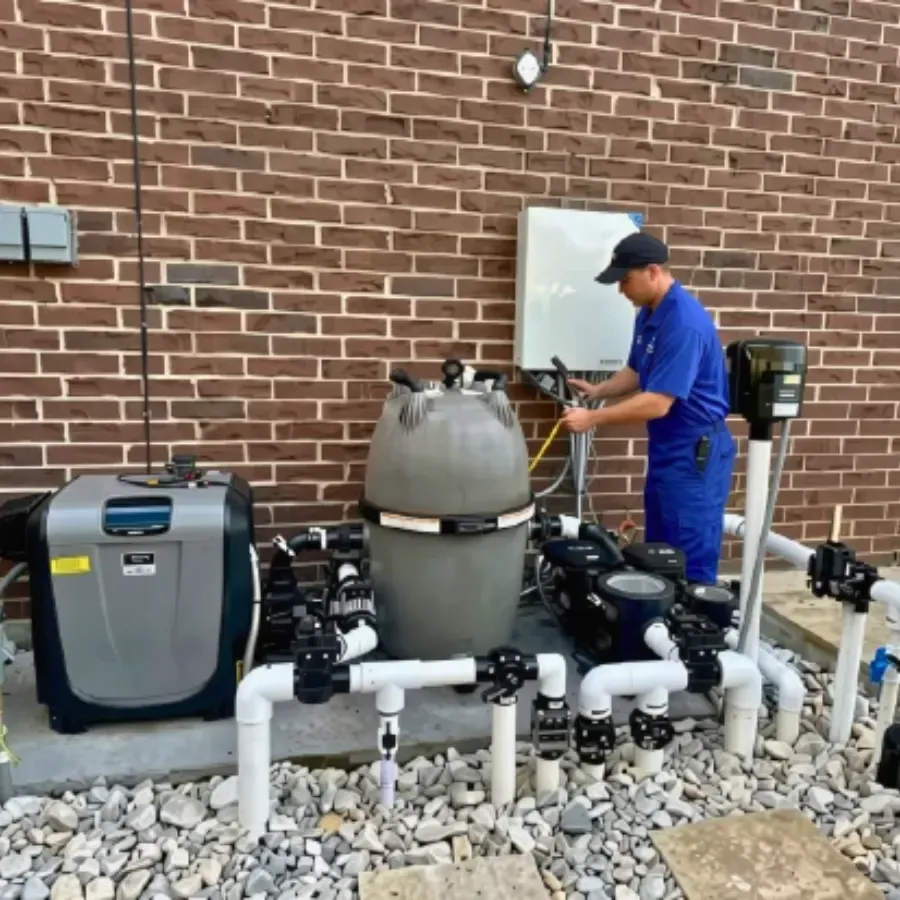
A filter that cannot catch fine particles will not clear the water even after chemistry is right. Marina’s pool filter service covers inspection, cleaning, and replacement if you suspect the filter.
Can storms and debris cloud the water?
Yes, which is cause 7. Rain dilutes chlorine and adds dirt and organic debris. Hydra says rain also introduces phosphates and nitrogen that feed algae. Pollen and leaves add to the load. Remove debris, brush, test, and let the filter work. For the full story, read why your pool turns green after a storm.
Could it be early algae?
Cause 8 is cloudy water that is about to turn green. Brush a wall. If the water gets worse or you see a slick film, treat it as algae. Hydra describes a recovery path of green, cloudy green, cloudy white, hazy, then clear, so cloudy white water after an algae cleanup is a normal stage. To compare types, see green, black, and mustard algae.
How do I tell which cause it is?
Start with the numbers, then the equipment, then the surroundings. If chlorine is low, fix that first, since low sanitizer lets everything else get worse. If chlorine is fine but pH, alkalinity, or hardness is high, those are your suspects. If the chemistry is in range, look at the filter and runtime. If the water changed right after rain, wind, or a party, think debris and runoff. Change one thing at a time and retest, so you know what worked. Write down each reading and the date. A short log helps a pro see a pattern.
What order should I fix things in?
- Test chlorine, pH, alkalinity, hardness, and stabilizer.
- Fix the reading that is farthest off. Follow every product label.
- Empty baskets and clean the filter.
- Run the pump until the water clears.
- Retest. Repeat if needed.
CDC warns that pool chemicals can injure people when mixed or handled without protection. Keep each product in its own labeled container, dry, and away from heat. Never mix chemicals. Wait to swim until your readings are in range.
Our water chemistry chart lists target ranges in one place.
When should I call a pro?
Call if the water stays cloudy after you have fixed the numbers, if the filter pressure keeps climbing, or if you are not sure what is off. Marina Pool Services does weekly water balance for chlorine, pH, alkalinity, calcium hardness, and conditioner, and it also offers filter service and algae treatment.
Next step
Read about algae treatment from Marina Pool Services or its weekly pool service. Call (817) 896-1120 or use the quote form.
Frequently asked questions
Why is my pool cloudy even though I added chlorine?
Chlorine may not be working well. Pentair says an imbalance can make chlorine less effective, and high pH, alkalinity, or hardness can each cloud the water. Hydra Pool Services also says very high stabilizer makes chlorine weak. Test pH, alkalinity, and stabilizer, not just chlorine.
Why is my pool cloudy after a storm?
Rain dilutes chlorine and adds debris and nutrients. That can cause cloudy water and later algae. Test the water, clear debris, clean the filter, and run the pump. If it turns green, see our post on post-storm algae.
Is cloudy water safe to swim in?
Not until you know why. Cloudy water can mean low sanitizer. CDC recommends pH 7.0 to 7.8 and free chlorine of at least 1 ppm in pools, or 2 ppm with cyanuric acid. Test with a DPD kit before swimming.
How long does cloudy water take to clear?
It depends on the cause and the filter. Once chlorine and chemistry are right, the filter has to catch the fine particles, which can take a day or more with the pump running. Clean the filter if pressure rises.
Pool terms on this page
Sources
- CDC: Home Pool and Hot Tub Water Treatment and Testing
- CDC: Pool Chemical Safety
- Pentair: Pool Water Guide
- Hydra Pool Services: How to Fix a Green Pool Fast in Texas
Written by Marina Pool Services and checked against the sources above on October 21, 2026. City rules and product guidance change, so check the linked page before you act. Follow product labels for any pool chemical.